Yesterday while taking my son to swimming lessons, I managed to read a short story by Flannery O’Connor. She has been a topic of discussion recently with an issue of Credenda Agenda devoted to her and a brief mentioning on Dr. Haykin’s blog.
Flannery O’Connor was a Catholic writer who lived in the Protestant American South. Although I have significant theological qualms with Catholicism, I am very fond of the writing of three other Catholics: G.K. Chesterton, Graham Greene and J.R.R. Tolkien. Given my affinity for these Catholic writers, and after reading Doug Jones’ take on O’Connor in C/A, I decided to check out a collection of her writing from the local library.
To my delight, the story I read yesterday was remarkable. I have never been a fan of short stories; as an English teacher I have bumped short stories out of the courses I teach. But O’Connor seems to have perfected the art.
The difficulty I have with short stories is that they are “short”. Authors are limited in their ability to develop convincing and authentic characters or developing a sufficiently deep, rich and layered plot. Life is complex; short stories, because of their restrictive length are too simplistic—in terms of form.
In her story, “A View of the Woods,” O’Connor masterfully uses her economy of words to narrow her focus on one character. Good writers say more with less, and she has done this. The story is only twenty pages long, yet O’Connor draws in her reader into a deep and complex arena by using a number of ingenious techniques. The most profound is her use of narration. The story is told 3rd person limited omniscience—in other words, the story is told from a 3rd person perspective but the readers are only given access to one character’s personal thoughts (as opposed to 3rd person omniscient, where the reader has access to all the major character’s thoughts as well as actions). The result is effective. O’Connor “taints” the “objective” narrator’s perspective with that of one of the characters. This gives us a much deeper picture of the main character and enhances realism. In life we only have access to our own thoughts when we are trying to make sense of the world around us. O’Connor could have used first person to accomplish this, but instead she uses the façade of objectivity. This is highly appropriate because the lead character believes that he is omniscient and that only he sees the world objectivity and accurately, untainted by pedantic and small-minded perspectives of his family. The irony is, of course, that he is “limited” and he is “tainted”. Also, by using third person, O’Connor is able to expose this irony “inadvertently”—in other words, although the narrator is tainted by a limited perspective, it still must record events and dialogue as they occur. A first person narration has the liberty to “revise” the events recorded, forcing the reader to read between the lines.
She also uses vernacular very well; she not only conveys an authentic sounding Georgian accent, she also conveys “personality” through the speaking style of her characters. Her physical descriptions are brief but meaningful. She does more than paint a picture of her characters in the readers mind; she uses physical description to tell the reader something about her characters. The names are also important in this story. The protagonist is named Mr. Fortune and his ne’er-do-well son-in-law is named Mr. Pitts. She playfully yet unobtrusively uses these names to deepen the sense of irony in this story.
Most profound is her use of humor. The story was not a “comedy” at all, yet I did laugh out loud on a few occasions. Referring back to my comments about the limitations of short stories, O’Connor adds depth and authentic complexity by incorporating a range of human emotions in her story. Humor is a part of life in almost all circumstances. She uses it authentically and effectively.
Because of her Catholicism, O’Connor also “says” something from a grounded perspective. Unlike many of her contemporaries that write as though they are jelly fish awash in a sea of relativism, O’Connor is judging her character. He is a fool. He does the wrong thing. This “judgmental” perspective is not overt in the story; it is assumed. O’Connor assumes a Christian worldview, where there is such a thing as up and down. This is the heart of her authenticity. The world actually functions according to the Christian worldview. O’Connor is not attempting to preach a moralizing sermon. She is simply observing the world with the clarity of Christian understanding. Tolkien writes LOTR with this sort of depth. He too assumes a Christian worldview; as a result, Midde-earth is an authentic place in the reader’s mind. The reader can relate to the world of Tolkien and of O’Connor because it is a reflection of the world as it is.
Although my reading agenda is jammed packed this summer, I hope to squeeze in a few more O’Connor stories. I also think that more can be said about Catholic writers. Good writers, whether Catholic or not, observe the world with clarity and reflect it in their work accurately. The further removed a writer is from the Christian worldview, the harder it is for the writer to see clearly and retell accurately. When time presents itself, I would like to explore a Protestant Christian perspective on Catholic writers and their work.
Wednesday, August 02, 2006


Wednesday, July 26, 2006
Why the best Allegory is Christian Allegory: III
Why Narnia is not Allegory
The first reason the Narnia stories are not allegory is because Lewis says they’re not allegory. Being a scholar of Medieval and Renaissance literature, he did not, ironically, like allegory all that much. His intention in writing the Narnia stories was to tell the Christian story without “stained-glassed windows.” Allegory would work to accomplish this but he wanted the freedom to tell Bunyan’s story while creating a new and different story. For example, the White Witch is a Satanic-like figure, but she is not "representing" Satan in an allegorical way (see comments on "How allegory works" on blog post below). The Witch is an evil sorceress who is inadvertantly brought into our world and then into Narnia by young Digory in the The Magician's Nephew.
The difference between allegory and Aslan is that Aslan actually is the Lion of Judah as he manifests himself in a different universe. He does not represent Christ, he is Christ in a fictional context. The parallel universe of Narnia that Lewis created is fictional, of course, but in the fictional reality of the novels, Narnia is as real as Lucy Pevencie’s England, and Aslan is as real as Christ. Narnia does not symbolize our world; it is an entirely different world all together. That being said, Lewis wasn’t attempting to create an alternative religion of Aslan-worship. His purpose was to lead his readers to the real Jesus Christ. In the 1950s, a concerned mother wrote to C.S. Lewis stating that her son “loved Aslan more than Jesus.” In a lengthy and delightful reply, Lewis writes, “But Laurence can’t really love Aslan more than Jesus, even if he feels that’s what he is doing. For the things he loves Aslan for doing or saying are simply the things Jesus really did and said. So that when Laurence thinks he is loving Aslan, he is really loving Jesus: and perhaps loving Him more than he ever did before.”
Next blog: Why Christian Allegory is the best kind of Allegory
The first reason the Narnia stories are not allegory is because Lewis says they’re not allegory. Being a scholar of Medieval and Renaissance literature, he did not, ironically, like allegory all that much. His intention in writing the Narnia stories was to tell the Christian story without “stained-glassed windows.” Allegory would work to accomplish this but he wanted the freedom to tell Bunyan’s story while creating a new and different story. For example, the White Witch is a Satanic-like figure, but she is not "representing" Satan in an allegorical way (see comments on "How allegory works" on blog post below). The Witch is an evil sorceress who is inadvertantly brought into our world and then into Narnia by young Digory in the The Magician's Nephew.
The difference between allegory and Aslan is that Aslan actually is the Lion of Judah as he manifests himself in a different universe. He does not represent Christ, he is Christ in a fictional context. The parallel universe of Narnia that Lewis created is fictional, of course, but in the fictional reality of the novels, Narnia is as real as Lucy Pevencie’s England, and Aslan is as real as Christ. Narnia does not symbolize our world; it is an entirely different world all together. That being said, Lewis wasn’t attempting to create an alternative religion of Aslan-worship. His purpose was to lead his readers to the real Jesus Christ. In the 1950s, a concerned mother wrote to C.S. Lewis stating that her son “loved Aslan more than Jesus.” In a lengthy and delightful reply, Lewis writes, “But Laurence can’t really love Aslan more than Jesus, even if he feels that’s what he is doing. For the things he loves Aslan for doing or saying are simply the things Jesus really did and said. So that when Laurence thinks he is loving Aslan, he is really loving Jesus: and perhaps loving Him more than he ever did before.”
Next blog: Why Christian Allegory is the best kind of Allegory
Tuesday, July 25, 2006
Why the best Allegory is Christian Allegory: II
How does Allegory Work?
In Pilgrim’s Progress (1678) the protagonist named “Christian” flees the “City of Destruction” and travels through the various literal places in the narrative that also carries symbolic meaning. He trudges through a slough called the Slough of Despond. While in the slough, Christian experiences despondency. Later, he travels to a city called Vanity Fair and encounters garish and vain citizens; he visits a Doubting Castle, and (you guessed it), he doubts. The culmination of his journey occurs when he finally arrives at the Celestial City. The entire narrative is a representation of the human soul's pilgrimage through temptation and doubt to reach salvation in heaven.
In an allegory, the various elements of the story systematically parallel other events on a spiritual, historic or literary level. This differs from allusions or symbolism. Tolkien’s The Lord of the Rings, for example, makes many allusions to mythological archetypes evident in the Christian story. Gandalf, Aragorn and Frodo are all Christ-figures, but the LOTR is not an allegory. The allusions and symbolism are not systematic, nor are they intended to reflect a hidden Christian message. Providence is not only symbolically but literally present in the story.
Harry Potter is also a Christ-figure, as is Neo from the Matrix and Superman in the current film Superman Returns. Although these works carry symbolic weight, they are not allegories. Harry Potter does not represent Christ on a spiritual level; he is merely an archetype of Christ. Even the many Christ-allusions in Superman Returns do not make it a Christian Allegory. Here’s a few interesting allusions… Superman was “sent to earth by his father” to be a “light to humanity” and act as a “saviour”—Superman is beaten and humiliated by Lex and his gang is a bloodless homage to Gibson’s Passion of Christ. Superman “dies” saving the world from the new kryptonite continent… as he hurls the rock into outer space, Superman descends to earth is a brief crucifixion pose. After his death, he is resurrected. All this does not make Superman an allegory. Ironically, C.S. Lewis’s Chronicles of Narnia is also NOT an allegory. More on that next time.
Next blog: Why Narnia is not Allegory
In Pilgrim’s Progress (1678) the protagonist named “Christian” flees the “City of Destruction” and travels through the various literal places in the narrative that also carries symbolic meaning. He trudges through a slough called the Slough of Despond. While in the slough, Christian experiences despondency. Later, he travels to a city called Vanity Fair and encounters garish and vain citizens; he visits a Doubting Castle, and (you guessed it), he doubts. The culmination of his journey occurs when he finally arrives at the Celestial City. The entire narrative is a representation of the human soul's pilgrimage through temptation and doubt to reach salvation in heaven.
In an allegory, the various elements of the story systematically parallel other events on a spiritual, historic or literary level. This differs from allusions or symbolism. Tolkien’s The Lord of the Rings, for example, makes many allusions to mythological archetypes evident in the Christian story. Gandalf, Aragorn and Frodo are all Christ-figures, but the LOTR is not an allegory. The allusions and symbolism are not systematic, nor are they intended to reflect a hidden Christian message. Providence is not only symbolically but literally present in the story.
Harry Potter is also a Christ-figure, as is Neo from the Matrix and Superman in the current film Superman Returns. Although these works carry symbolic weight, they are not allegories. Harry Potter does not represent Christ on a spiritual level; he is merely an archetype of Christ. Even the many Christ-allusions in Superman Returns do not make it a Christian Allegory. Here’s a few interesting allusions… Superman was “sent to earth by his father” to be a “light to humanity” and act as a “saviour”—Superman is beaten and humiliated by Lex and his gang is a bloodless homage to Gibson’s Passion of Christ. Superman “dies” saving the world from the new kryptonite continent… as he hurls the rock into outer space, Superman descends to earth is a brief crucifixion pose. After his death, he is resurrected. All this does not make Superman an allegory. Ironically, C.S. Lewis’s Chronicles of Narnia is also NOT an allegory. More on that next time.
Next blog: Why Narnia is not Allegory
Sunday, July 23, 2006
Why the best Allegory is Christian Allegory: I
 What is Allegory?
I would like to begin a series about allegory. The discussion recently came on church historian Dr, Michael Haykin’s blog, Historia Ecclesiastica, where he confessed to having not read Pilgrim’s Progress because of a dislike for allegory. I have always been partial to allegory, so I thought it would be fitting to write a bit about it in a seven part series entitled, "Why the best Allegory is Christian Allegory."
Allegory comes from the Greek word “allegoria” which translates as “speaking otherwise.” This concenpt is at the heart of what an allegory is. Essentially, an allegory is a piece of writing (poetry or prose) in which characters, events, and ideas in the piece represent something else on a symbolic level. The symbolism is systematic, functioning like an extended metaphor. In addition, an allegory usually conveys a moral lesson to its readers.
Among the most famous Christian allegories are such works as John Bunyan’s Pilgrim’s Progress and Spencer’s Faerie Queene. During the English Medieval and early Renaissance, allegory was a very popular moral and religious didactic form of literature. But allegory is not an exclusively Christian form of literature. The Greeks also occasionally wrote allegory. George Orwell’s Animal Farm is another famous allegory, as well as Swift’s Gulliver’s Travels. The latter two works expressing decidedly political perspectives.
Next blog: "How does Allegory Work?"
Friday, July 21, 2006
An Odyssey in Reading
I have been reading Homer’s The Odyssey this summer. I will be teaching it in the fall. Usually I avoid work related reading during the ephemeral and fleeting summer months. However, I have been meaning to read this classic of Western literature for a number of years. I think my hesitancy to engage Homer was a result of my fear of the text. In the hidden depths of my being, I think I subconsciously perceived that The Odyssey and The Iliad were scholarly and enigmatic masterpieces that exceeded my ordinary and average cerebrum.
My subconscious, however, was wrong. The epic poem is a delight to read. It is very accessible and at times (surprisingly) very simplistic. I discovered that Homer was writing long before the absurd and truly enigmatic prose of the 20th century post-moderns. In stead of harping on complex and psychologically deformed anti-heroes of modern prose, Homer addresses themes and issues that ring true to the very centre of our humanity. As a Christian reader, I am given insight into a truly human hero, Odysseus, and I can compare and contrast this view with the truly divine Christ-hero.
Homer is not high brow. He is for the Everyman. Take up and read, Everyman.
(Robert Fagles’s recent poetic translation comes highly recommended. See also Peter Leithart’s Heroes of the City of Man for Christian commentary of Homer and other classic works)
My subconscious, however, was wrong. The epic poem is a delight to read. It is very accessible and at times (surprisingly) very simplistic. I discovered that Homer was writing long before the absurd and truly enigmatic prose of the 20th century post-moderns. In stead of harping on complex and psychologically deformed anti-heroes of modern prose, Homer addresses themes and issues that ring true to the very centre of our humanity. As a Christian reader, I am given insight into a truly human hero, Odysseus, and I can compare and contrast this view with the truly divine Christ-hero.
Homer is not high brow. He is for the Everyman. Take up and read, Everyman.
(Robert Fagles’s recent poetic translation comes highly recommended. See also Peter Leithart’s Heroes of the City of Man for Christian commentary of Homer and other classic works)
Wednesday, June 07, 2006
Real Men Read Austen
A few months ago, I published this blog posting on the College & Career blog for my church, Pilgrim Baptist Fellowship. I felt it was worth publishing again on my personal blog.
When I was in University, I took a course on the "novel"--we looked at literature from Cervantes, Flaubert, Dostoevsky to Conrad and Angela Carter. Out of all the novels, my professor, who was a man, stated that his favourite author was Jane Austen. Another teacher of mine, Dr. Michael Haykin, Church Historian and Principal at Toronto Baptist Seminary is also a Jane Austen fan. What is it with men and Austen? Isn't Pride and Prejudice a romance novel? Yes, there is romance, but it is a real, tangible and profound sort of romance.
Peter Leithart, who wrote a number of excellent literary companions (Brightest Heaven of Invention about Shalespeare, Ascent to Love about Dante and Heroes of the City of Man about Greek and Roman epics) also worte a book about Austen, entitled, Miniatures and Morals: The Christian Novels of Jane Austen. In this excellent book, which I gave my wife (an Austen fan) on Dr. Haykin's suggestion, Leithart writes this about real men and reading Austen:
When I was in University, I took a course on the "novel"--we looked at literature from Cervantes, Flaubert, Dostoevsky to Conrad and Angela Carter. Out of all the novels, my professor, who was a man, stated that his favourite author was Jane Austen. Another teacher of mine, Dr. Michael Haykin, Church Historian and Principal at Toronto Baptist Seminary is also a Jane Austen fan. What is it with men and Austen? Isn't Pride and Prejudice a romance novel? Yes, there is romance, but it is a real, tangible and profound sort of romance.
Peter Leithart, who wrote a number of excellent literary companions (Brightest Heaven of Invention about Shalespeare, Ascent to Love about Dante and Heroes of the City of Man about Greek and Roman epics) also worte a book about Austen, entitled, Miniatures and Morals: The Christian Novels of Jane Austen. In this excellent book, which I gave my wife (an Austen fan) on Dr. Haykin's suggestion, Leithart writes this about real men and reading Austen:
I insist that “real men read Austen” and can read her with interest and profit. Austen, after all, created some very striking male characters. Some of her heroes are more than a little effeminate; Edward Ferrars in Sense and Sensibility is painfully silent in much of the book, though that is in part due to a depression caused by his secret engagement to the manipulative Lucy Steele, which is plenty to take the pluck out of a man… Austen’s other heroes, however, are strong and forceful personalities, and definitely not effeminate. All her great heroes—Darcy, Wentworth, Edmund Bertram, Knightley—are men who hold positions of authority and use those positions for good. Each of them is a Christlike lover who sacrifices, often at some cost to his reputation, to win his bride. They are servant heroes, not macho-heroes. For Austen, machismo is just Spanish for “bluster” and is the mark of villainy.Even without considering her strong male characters, Austen’s novels are highly instructive for men. The mere fact that her novels give men an opportunity to see romance through the eyes of an uncommonly perceptive woman should be enough to recommend them. Even if men do not want to see courtship through a woman’s eyes, who can say we do not need to? She has a strong sense of a man’s role in courtship and his responsibility for the course that courtship takes. More then one male character in her novels proves himself a scoundrel by playing with the affections of a woman. Austen’s first rule of courtship is one I have frequently repeated to my sons: Men are responsible not only for behaving honourably toward women but also for the woman’s response; if a man does not intend to enter a serious relationship, he has no business giving a woman special attention or encouraging her to attach herself to him. Austen sees clearly that men who play with women’s affections are fundamentally egotistical. They want the admiration and attention of women without promising anything or making a commitment...…Nothing happens in Austen… Yet precisely because of this limitation, because so little seems to happen, every nuance and contour of what does happen takes on considerable importance. We begin to realise that men can be cads without kidnapping women and confining them in dark towers, and women can be vicious without poisoning their rivals.
Tuesday, June 06, 2006
Taking Flight in Christ
George Herbert wrote a number of poems using a method called “concrete poetry” or “form poetry”, where the layout of the poem reflects meaning. Such a poem, called “Easter-Wings”, is shown below:

As you can see, the poem looks like “wings”. The poem is about the restored freedom we receive in Christ as a result of Easter. That freedom is symbolized by the wings. One cannot help but think of Isaiah 40:31, where we read “Yet those who wait for the LORD will gain new strength; They will mount up {with} wings like eagles, They will run and not get tired, They will walk and not become weary.” Take note how the form fits meaning:
The opening line begins with God creating humanity in “wealth and store”—note that the line is long. As sin enters the picture, the lines decrease in length until humanity is reduced to two words: “most poore”. Then, the turning point of the poem begins with “With thee”—in other words, with God. Herbert is emphasizing that spiritual healing, spiritual restoration, begins with God. As the lines increase, so does the crescendo of hope, which began with God’s intervention. Herbert draws in the flight metaphor into the text with renewed spiritual flight: “O let me rise / As larks […] further the flight in me” He also extends the metaphor to harmony of birds in flight as well singing. The second stanza in the poem set goes as follows:
The length of the opening line here implies the extent and weight of sorrow as a result of sin. The result is a withering of the soul and, as form suggest, the poem. This withering continues until the poem is reduced to two words: “most thinne”. Both the poem and the soul of the speaker have become thin. But! But “With thee” the crescendo of hope and promises is restored. “For,” the speaker argues, “if I imp my wing on thine, / Affliction shall advance the flight in me.” To “imp” is an obscure term meaning to repair or graft feathers into a wing to increase flight. When we are grafted into Christ, we can fly to spiritual heights. Jesus said, “I am the vine; you are the branches. Whoever abides in me and I in him, he it is that bears much fruit, for apart from me you can do nothing” John 15:5. Like Christ, who endured much sorrow and affliction on the cross, we too will suffer affliction and rejection in this world. However, if we cleave to Christ, our suffering will not be in vain, as His suffering was not in vain. Our sorrow will turn to joy. The promised Holy Spirit will come as our helper, and will draw us to Christ. The Spirit is often symbolized in Scripture as a dove, and so the metaphor takes further significance.
"Easter Wings" is a superb poem that exudes both poetic and spiritual beauty. "With Thee, let us rise, as larks, harmoniously, and sing this day thy victories!"

As you can see, the poem looks like “wings”. The poem is about the restored freedom we receive in Christ as a result of Easter. That freedom is symbolized by the wings. One cannot help but think of Isaiah 40:31, where we read “Yet those who wait for the LORD will gain new strength; They will mount up {with} wings like eagles, They will run and not get tired, They will walk and not become weary.” Take note how the form fits meaning:
Easter-wings
Lord, who createdst man in wealth and store,
Lord, who createdst man in wealth and store,
Though foolishly he lost the same,
Decaying more and more,
Till he became
Most poore:
With thee
O let me rise
As larks, harmoniously,
And sing this day thy victories:
Then shall the fall further the flight in me.
The opening line begins with God creating humanity in “wealth and store”—note that the line is long. As sin enters the picture, the lines decrease in length until humanity is reduced to two words: “most poore”. Then, the turning point of the poem begins with “With thee”—in other words, with God. Herbert is emphasizing that spiritual healing, spiritual restoration, begins with God. As the lines increase, so does the crescendo of hope, which began with God’s intervention. Herbert draws in the flight metaphor into the text with renewed spiritual flight: “O let me rise / As larks […] further the flight in me” He also extends the metaphor to harmony of birds in flight as well singing. The second stanza in the poem set goes as follows:
My tender age in sorrow did beginne:
And still with sicknesses and shame
Thou didst so punish sinne,
That I became
Most thinne.
With thee
Let me combine
And feel this day thy victorie:
For, if I imp my wing on thine,
Affliction shall advance the flight in me.
The length of the opening line here implies the extent and weight of sorrow as a result of sin. The result is a withering of the soul and, as form suggest, the poem. This withering continues until the poem is reduced to two words: “most thinne”. Both the poem and the soul of the speaker have become thin. But! But “With thee” the crescendo of hope and promises is restored. “For,” the speaker argues, “if I imp my wing on thine, / Affliction shall advance the flight in me.” To “imp” is an obscure term meaning to repair or graft feathers into a wing to increase flight. When we are grafted into Christ, we can fly to spiritual heights. Jesus said, “I am the vine; you are the branches. Whoever abides in me and I in him, he it is that bears much fruit, for apart from me you can do nothing” John 15:5. Like Christ, who endured much sorrow and affliction on the cross, we too will suffer affliction and rejection in this world. However, if we cleave to Christ, our suffering will not be in vain, as His suffering was not in vain. Our sorrow will turn to joy. The promised Holy Spirit will come as our helper, and will draw us to Christ. The Spirit is often symbolized in Scripture as a dove, and so the metaphor takes further significance.
"Easter Wings" is a superb poem that exudes both poetic and spiritual beauty. "With Thee, let us rise, as larks, harmoniously, and sing this day thy victories!"
Tuesday, May 23, 2006
A Poet On Prayer
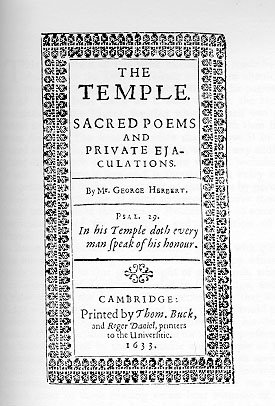 George Herbert on Prayer
If you have been following my blog, you will know that I am reading 16th C English poet George Herbert’s masterpiece, The Temple, a collection of pious poems on various and sundry topics. I recently came across this beautiful poem on prayer. May it encourage you to be a man or woman of prayer.
Prayer
Prayer the Church's banquet, Angels' age,
God's breath in man returning to his birth,
The soul in paraphrase, heart in pilgrimage,
The Christian plummet sounding heav'n and earth;
God's breath in man returning to his birth,
The soul in paraphrase, heart in pilgrimage,
The Christian plummet sounding heav'n and earth;
Engine against th' Almighty, sinners' tower,
Reverséd thunder, Christ-side-piercing spear,
The six-days world transposing in an hour,
A kind of tune, which all things hear and fear;
Softness, and peace, and joy, and love, and bliss,
Exalted Manna, gladness of the best,
Heaven in ordinary, man well dressed,
The Milky way, the bird of Paradise,
Church-bells beyond the stars heard, the soul's blood,
The land of spices; something understood.
Monday, May 22, 2006
Sir Arthur Conan Doyle's B-day Today!
 Ever since I was a boy, I desperately wanted a magnifying glass, a double brimmed deer-stalker hat and a curved tobacco pipe like the iconic image of Sherlock Holmes. I still enjoy the stories of Holmes. I find Sir Arthur Conan Doyle's stories to be extraordinarily entertaining.
The Holmes stories are one of the most popular and enduring serial stories ever published. Doyle wrote the stories for a periodical magazine called The Strand. The success of the series was partly due to the form in which the stories appeared. The Holmes stories are written “first person narrative” from Dr. Watson’s perspective. Watson is not only a character and participant in the adventures of Holmes, but also the reader’s personal guide. Since Watson is an old friend of Holmes, we the reader are able to see Holmes through his accustomed eyes. Holmes instantly becomes a man who we are familiar with. Combined with this familiarity, however, is an enduring sense of mystique. For although Watson is an old friend—who lived as a bachelor with Holmes for quite some time—Watson still doesn’t really “know” Holmes. As Holmes’ behaviour and genius surprises Watson, so he surprises the reader. As narrator, Watson is also able to ask the questions we, the readers, would like to ask Holmes. “How did you figure it out, Holmes?” Watson asks. Holmes then gives Watson—and us—the answer.
Since Watson is both an observer as well as a participant, his narrative is given additional credibility. The adventures are more realistic, since they are told by a first-hand witness. Because Watson is a Doctor, his approach to recording the adventures of Sherlock Holmes is accurate and methodical. I am reminded of Dr. Luke and his account of the adventures of the Apostles Peter and Paul. Like Luke, Watson pays close attention to detail and records these details as plainly as he witnesses them.
Watson also acts as a “foil” for Holmes. Watson is in many ways the exact
 opposite of Holmes; as much as Holmes is extraordinary, Watson is ordinary. The reader can relate to Watson: he is married, he keeps ordinary hours, he enjoys a good meal, he is concerned with people. Watson’s humanity is set against Holmes’ purely logical mind. Holmes is never interested in a case because of the people involved unless there is some curios aspect about them; he is motivated by the case itself, the mystery. He is a scientist of the truest sense. Watson, who is a medical doctor, is less interested in the science of medicine as with helping people with the science of medicine. So Watson provides not only contrast, but also balance to the Holmes’ adventures.
Holmes is not inhuman though. We see glimpses of his humanity when he plays his violin or when he is on a heroine binge. We can relate to his need for a “thrill”—whether it be solving a strange mystery or from a narcotic. In some ways, we the readers are addicted to Holmes himself. He is an intoxicating character.
The Watson-Holmes appeal rests also on the simple fact that we love to read about this wonderful friendship. Some of the greatest stories in English literature celebrate friendship. There’s Sam and Frodo, Crusoe and Friday, George and Lennie, Ralph and Piggy, Harry and Falstaff.
Holmes never actually said, “Elementary, my dear Watson”—but, Doyle could have very well said it himself. He created one of the most enduring yet elementary and formulaic story-characters of all time.
Sunday, May 21, 2006
Art of Teaching Writing Part 2
 Boring Lessons 101 "How to Write"
A challenge to teaching writing in the English classroom is that it can be a really boring subject. “Writing” as a topic seems to be deficient when compared to other topics of the English classroom; it lacks the excitement and natural appeal of a novel or play and the provocation and mystery of poetry. Part of the problem is that students feel they are already experts. Why rehash material they already know? Students have been hammered over the head with “how to write” every single year of their educational stint. They have encountered the “hamburger” model, the "layered cake" model, the "tossed salad" model (I just made that one up now), the pre-plan chart model, the five-paragraph model… the list goes on. For some students the notion of teaching “writing” in English is like the teaching of “walking” in Phys-Ed.
As my students prepared for a comparison essay that I am currently marking, I told them that in real life, they will never write an essay like this again. In other words, academic essays serve no purpose in themselves outside the academic world. (How’s that for a motivator?). I made the case, however, that essays require you to think critically and creatively on a subject. Essays require you to develop a logical and persuasive argument. Essays require you to know the text and to evaluate evidence. Essays require you to communicate, on paper, with clarity and style. All of these skills you will use in life. That being said, Bruce Pirie, in his book on English education, recently rocked my world.
Alternatives to the Essay?
In Reshaping High School English, Bruce Pirie argues that student writers need to ask, “What shape is demanded by what I am trying to say?” (77). I felt I was encouraging my students to ask this question by having my students write with these question in mind: How many paragraphs, points, factors, pieces of evidence should be included in an essay to best make my case? What the student is trying to communicate to the reader should determine the number of paragraphs, points, style, etc. Pirie, however, goes beyond number of paragraphs and factors. He wants writers to ask what “shape”—by which he means that the “essay” is only one possibility. Pirie argues that there are other means to teach communication and critical thinking skills and he suggests some ways. I agree. He also argues powerfully that essays encourage students to view themselves as authorities rather than encouraging “tentative and cooperative exploration” (86). I do not want my students to consider themselves to be experts and then just give their opinions; rather, I want them to give a position based on the text—to submit their thinking to the text. I was hoping my students would not spout off unfounded opinions; I was hoping they would give intelligently considered positions based on a solid, evidence-laden argument. But, in the end, I believe I am asking my students to become an “authority on some aspect of the subject,” as Pirie suggests (80). Blast you, Bruce Pirie!
In a daunting and formal arena like academic essays, most students doubt their own thinking anyway and replicate teacher lectures, Spark Notes, and other fine resources. Uncertainty of one’s own position is an important step, sometimes, to true learning. Pirie points out, however, that teachers sacrifice “uncertainty” on the altar of the “illusion of mastery” (80). Despite the alternative options—“shapes” as Pirie calls it—for communicating ideas, the essay still stands out as a formidable assignment. The essay is a serious arena for critical thinking; students tend to apply themselves with greater gusto because the essay presents a serious and sophisticated venue for their thinking (when they do, actually think). I am torn. I must get to work marking these blasted essays, which may or may not be of any pedagogical value.
Story-telling vs. the Essay
Let me close with C.S. Lewis. Awhile back, I was reading The Horse and His Boy to my son and I came across this little tidbit: “Aravis immediately began, sitting quite still and using a rather different tone and style from her usual one. For in Calormen, story-telling (whether the stories are true or made up) is a thing you are taught, just as English boys and girls are taught essay writing. The difference is that people want to hear the stories, whereas I never heard of anyone who wanted to read the essays.” Too true.
Works Cited
Lewis, C.S.. The Horse and His Boy. USA: Harper Collins, 1994.
Pirie, Bruce. Reshaping High School English. Toronto: Natl Council of Teachers, 1997.
Click here for Part 1: Bacon, Chickens and the Art of Teaching Writing
Monday, May 15, 2006
Christians and their Imagination

“Fairy Tales are more than true; not because they tell us that dragons exist, but because they tell us that dragons can be beaten.”
G.K. Chesterton
Every year I make a list a books that I feel I ought to read. I sort my annual reading list into categories. Some of my headings include such books as Theology, Pastoral or Homiletic, Church History, Christian Biography, a Journal or Collection of Letters. Added to the list of clearly “spiritual” headings are such books that fall under the categories of poetry, novel, mystery/fantasy novel. I believe that fiction has as much importance in my spiritual growth as does my yearly “theology” book.
 Christians need to nurture their imagination. It takes a mind that is able to “imagine” in order to savour the beauty and to understand the depth of the work of Jesus on the cross. It takes an imagination to empathise with and love your neighbour. Nowhere in scripture are we commanded to read fiction; however, Jesus not only taught using “story,” he also lived the greatest story ever told. As Douglas Wilson writes, “The story of the gospel is a glorious story.” The gospel is a story, a true story. A story that regenerate and Spirit-filled men and women understand, a story that regenerate and Spirit-filled imaginations love. Christian imagination can be fostered by reading fiction. Over the next month or so, I plan to make a case for Christians reading fiction.
On the subject of poetry and Christianity, Christian poet, George Herbert, writes in his definitive work, The Temple,
Harken unto a Verser, who may chance
Ryme thee to good, and make a bait of pleasure.
A verse may finde him, who a sermon flies,
And turn delight into a sacrifice.
Friday, May 12, 2006
Bacon, Chickens and the Art of Teaching Writing
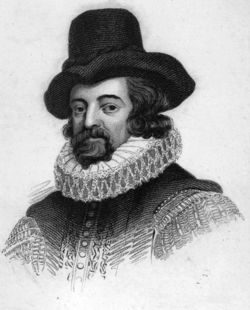 “Reading makes a full man; conference a ready man; and writing an exact man.”
Francis Bacon
I always begin my school year by telling my students about Francis Bacon. Bacon, I tell them, pioneered the Inductive Method of Scientific Inquiry. In a nutshell, he proposed that philosophers actually test their theories and make conclusions based on observation. I also tell my students that Bacon died as a result of his Inductive Method; after completing an experiment with raw poultry and ice (hypothesizing that ice could preserve raw meat), he caught pneumonia and died. I embellish the story by adding details about Bacon inventing bacon and experimenting with frozen turkeys. Lastly, I tell my students he invented the “essay”—it is at this point that my students suddenly lose all interest in this man. The image of a 16th Century man stuffing snow inside a raw chicken out on some wintery snow covered slope does not repulse my students. It is the essay. Why is it that essays inspire such dread and despair in our students?
 Teaching writing is perhaps the most challenging aspect to teaching High School English. This is especially true when teaching the formal academic essay. Getting students to communicate their ideas in a clear and intelligent fashion—even getting them to have “something” to communicate at all—can be difficult. Over the next few weeks, I will be posting on the topic of "Teaching Students How to Write Essays"
Process
One of the big issues surrounding writing is “process”—taking the time to edit, refine and polish writing, sometimes multiple drafts. Process is essential to any good writing, but the problem is that students lack the desire to wrestle with their writing. I always remind my students that “nothing is sacred”—even the most beautiful sentence, if it detracts from your overall intended meaning, needs to be hacked. Lack of clarity is the first reason to hack a sentence or two. To help my students understand the need for clarity, I have them read each other’s drafts. I also do one-on-one conferencing, but I feel peer editing is an important part in the process. Peer editing has many pitfalls; some peer editors are better than others, and peer editing doesn’t work in all situations (e.g., writing an essay on the same topic). However, with peer editing, students begin to see themselves as readers as well as writers. If they can experience what a reader goes through when they read a sloppy, unpolished piece of writing, then they will have a better understanding of how they need to revise their own work for clarity.
Exemplars
In creative writing, good writers are good readers. We all agree on this point. To prepare a class to write a short story, we would have our students read and discuss the craft of a variety of short stories. Ironically, we often expect our academic students to write essays without actually reading essays. I think many teachers are leery about having students read published essays because published essays—dare I say—never follow the five paragraph model. If teachers were willing to reject the five paragraph essay formula (more on this topic later), then teachers would be willing to have their students read and respond to “real” essays. Why not have our students read essays in preparation of their own essay writing?
The last thing I want is my students writing an essay the way Mr. Johnston wants it because he gives out the grades. What I want is my students writing in the way that best communicates their ideas. Reading published essays—not just student exemplars, I mean the real deal—reading published essays will help our students to see essay writing as “communication” not “hoop jumping”—communication that needs to be refined and honed, in order to best convey their intended meaning.
Subscribe to:
Posts (Atom)