Showing posts with label Poetry. Show all posts

Tuesday, April 07, 2009

Why do students hate poetry?

Why do students hate poetry? One of the main reasons students dislike poetry, I suggest, is because students have been trained to look for “story” in all the literary works they encounter. Overemphasis on story is evident in the sort of literature students are asked to study.

The bulk of teacher-sanctioned classroom reading material is narrative.

Novels, movies, short stories and graphic novels provide clear, discernible plots for our students to find; poetry offers them a sublime experience that is discernible only after a concerted effort on the part of the reader.

This overexposure to narrative fiction, coupled with the fact that we live in a time when entertainment and information come in flashy, overly explicit and simplified forms, results in our students' aversion to the seemingly "dull", implicit and complicated forms of poetic expression.

Why we should emphasize POETRY instead of PROSE

Human beings have a natural affinity for story; we tell stories, we enjoying hearing and watching stories and we understand our lives in terms of story. Literary education has capitalized on this natural love of story in order to foster student interest. This is not necessarily a bad thing. However, teaching “story” has been over-emphasized. Whether in the form of comic books, graphic novels, plays, movies, short stories or novels, “story” has been the backbone of English education.

The consequence is that students now expect to find plot is almost every piece of creative writing they encounter. When poetry is taught, many teachers choose to teach ballads or narrative poetry. Even in narrative poetry, however, “plot development” is rarely the raison d'être. As a result, when a student encounters a lyric poem, or if the narrative is veiled or vague, he throws up his arms in despair: “pointless”—“I don’t get it”—“stupid”—in other words, the student is impatient for clear meaning because that is what he has been taught to look for.

Certainly great literature is more than “plot”; however, many students miss the “poetic” aspects of prose because they can easily and effortlessly understand the story. Since that is what they are used to look for, they often stop there. I have heard many English teachers complain that students provide “plot summary” instead of analysis. Understanding plot is the effortless part of reading prose fiction. A good story teller should be able to clearly convey plot! When a student is asked to find the “deeper” meaning of a novel or short story, they are really being asked to understand the poetic meaning. The symbols, extended metaphors, allusions, imagery, etc. of a novel are the poetic elements. This is, I argue, the heart of literary exploration. Reading plot summaries is not reading literature. Reading and understanding the poetry within the prose is what true literary reading is all about. Plot can be a distraction to poetic understanding. Therefore, in early years, we should begin teaching students more poetry and less prose. We should also emphasize poetry in our curriculum from K-12. Poetry is the gateway to understanding all other forms of literature.

Thursday, April 24, 2008

So many poets, so little time...

Last Sunday, I began a seminar series at my church called “The Christian and Literature.” I attempted to make a case for Christians fostering a poetic imagination and viewing the world as “story”—God’s story.

This Sunday, I will continue the series by looking at poetry. John Piper writes, “Imagination is like a muscle. It grows stronger when you flex it. And you must flex it… Imagination is also contagious… So I suggest that you hang out with people (mainly dead poets) who are full of imagination.”

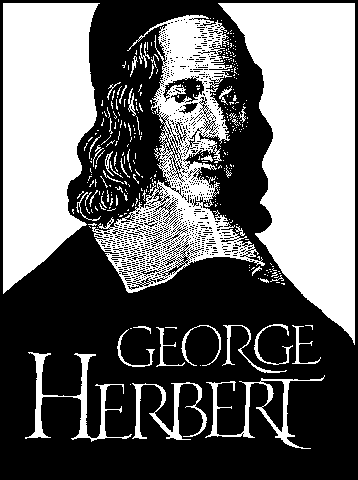
Piper recommends Christians spend time with some dead poets. So, that is the plan. Some dead poets I hope to take a look at are Isaac Watts (who penned over 700 hymns), George Herbert (one of C.S. Lewis’s favourite poets), John Donne, John Keats, William Blake, William Wordsworth, Langston Hughes, Robert Herrick and a handful of others. We may also take a peek at Milton and an excerpt from Beowulf.

There is so much rich and rewarding poetry… where to begin?

Monday, March 17, 2008

Happy St. Paddy’s Day


Today is March the 17th, St. Patrick’s Day. The day is celebrated in honour of Saint Patrick, the 4th Century missionary who brought Christianity to the emerald isle and according to legend he expelled all the snakes from Ireland. He also explained the concept of the Trinity to the Irish using a shamrock.

Although we had no green beer or Guinness on hand, in honour of this day, we had a bowl of Lucky Charms, read some Irish folktales, drank a mug of green-coloured Kiwi-Raspberry “smoothy” and we listened to some Irish music CDs.

This is a special day in our house because Irish blood courses through our veins. In truth, I am only partially Irish; I have a great-great-grandfather---an Ulsterman---who settled in Canada from the northern part of Ireland and my great-grandmother is the grand-niece of Irish-Canadian Thomas D’Arcy McGee.

Everyone has a relative with some claim to fame, and mine is Thomas D’Arcy McGee. He was one of the Fathers of Confederation; in addition to being a politician and founding father of this nation, he was also a poet. He published over 300 poems in his lifetime. Below is an excerpt of a poem he wrote entitled, “St. Patrick’s First Converts” and tells the story of Patrick’s initial contact with Irish natives on his missionary journey:

Upon finding Saint Patrick praying on the shores of Ireland, the Irish natives ask “Where dwells your God?”

The Saint replied, “Oh, nobly born!
Haply encounter’d here this morn;
You ask the only truth to know
That Adam’s children need below;
Your quest is God, like them of old
Who found the gravestone backward roll’d
From where they left the Saviour cold.”

Mildly to tell, the holy man
The story of our faith began---
Of Eve, of Christ, of Calvary,
The baleful and the healing tree;
Of God’s omnipotence and love,
Of sons of earth, now saints above;
Of Peter and the Twelve, of Paul,
And of his own predestined call.

“Not on the sea, not on the shore,
In solemn woods or tempest roar,
Dwelleth the God that we adore.
No! wheresoe’er His cross is raised,
And wheresoe’er His name is praised;
The pure life is His present sign,
The holy heart His favourite shrine;
The old, the poor, the sorrowful,
To them He is most bountiful;
Palace or hovel, land or sea,
God with His servants still will be!”

Tuesday, February 19, 2008

On writing poetry...

“It’s silly to suggest the writing of poetry as something ethereal, a sort of soul-crashing emotional experience that wrings you. I have no fancy ideas about poetry. It doesn’t come to you on the wings of a dove. It’s something you work hard at.”
---Louise Bogan


In the last post on What is Poetry?, I included Burton Raffel's definition for poetry as a "disciplined, compact verbal utterance, in some more or less musical mode, dealing with aspects of internal or external reality in some meaningful way." I think modern readers and writers of poetry have a hard time with the word "disciplined." Horace, the great Roman poet, writes, "Not gods, nor men, nor even booksellers have put up with poets being second-rate." Excellence doesn't simply occur; it is achieved. A poet must account for every jot and tittle in his poem. In poetry, there is no room for excess and overindulgence. Being concise takes discipline and hard work.

What is poetry?

What is poetry?

What is poetry? What is the difference between poetry and prose? What is prose, for that matter.

The first question to answer is the easiest: what is prose? Prose is “ordinary” and “straightforward” writing. The Oxford English Dictionary defines prose as “language in the form in which it is typically written (or spoken), usually characterized as having no deliberate metrical structure (in contrast with verse or poetry)” The word "prose" originates from the Latin “provertere” which means to turn forwards. In otherwords, prose is straightforward and clear. Examples of prose are novels, short stories, essays, plays, articles, speeches, dialogues, etc.. Unless you are reading a James Joyce novel, the language of the novel is clear and straightforward. One of the primary goals of a writer of prose is to clearly communicate ideas and events to the reader. If an essay is not clear, straightforward and direct, then it will receive a failing grade.

So what is poetry then? Poetry is “extraordinary” and “complex” writing. W. Somerset Maugham calls poetry “the crown of literature… It is the end and aim. It is the sublimest activity of the human mind. It is the achievement of beauty and delicacy. The writer of prose can only step aside when the poet passes.”

There is poetry in prose and prose in poetry. However, poetry stands distinct from all other forms of writing. Poetry is distinct historically. Poetry is the oldest form of human writing. For thousands of years, poetry was the means of human expression. Ancient epics like the Odyssey and the Iliad, both written in dactylic hexameter. Most of the pre-Socratic philosophers wrote in poetic form. Poetry remained paramount in the world of literature well into the 20th century.

However, the historical importance of poetry doesn't answer the question "What is poetry?" What is it about poetry that makes it so important and so distinct? Why is it “the sublimest activity of the human mind”? What is poetry?

The challenge in defining poetry is that poetry by its very nature defies “defining”—to define something means that you determine the boundary or limits of something. The OED uses the words “limit, restrict, confine.” If your defintion of poetry is too specific, too limiting, then it fails to capture the expansive nature of poetry. In order to “work” as a poem, poetry needs to defy the boundaries of ordinary language. I tell my students that poetry conveys more than words can tell. Where prose is limited to the literal and abstract meaning of words, poetry is able to pack incredible meaning and depth into the words, going beyond lexical meaning to higher levels of connotation and implication. In essence, poetry is compressed language. So much is packed into so little words. Delving into a good poem is like splitting an atom; the reader unleashes the power bundled up inside the words, commas and metaphors.

To try to define poetry is like trying to capture the wind. Once you “bag” the wind, it ceases to be “wind”. The answer to “What is Poetry?” must be broad enough to permit the creative and boundary-breaking aspects of great poetry. In his book, How to Read a Poem, Buron Raffel answers the question by defining poetry in the following way: “Poetry is a disciplined, compact verbal utterance, in some more or less musical mode, dealing with aspects of internal or external reality in some meaningful way.”

What is poetry? Raffel’s definition is the best I have ever come across. Many definitions are either too narrow (e.g., poems must rhyme) or the definitions use poetry to define poetry: take Emily Dickinson’s definition of poetry: “If I feel physically as if the top of my head were taken off, I know that is poetry.” Perhaps more obscure is e.e. cummings’ definition of poetry; poetry is “the algebra of the heart”.

Even though Raffel’s definition is far more useful because it is written in prose, the poetic definitions seem to capture the essence more powerfully. Thomas Gray’s defines poetry as “thoughts that breathe, and words that burn.”

Thursday, February 14, 2008

Poetry: The Good, the Bad and the Ugly

Yesterday morning I began teaching poetry to my English students. I argue that poetry is the most powerful means of communicating the “human experience” to other human beings. Where prose “tells” and art “shows” and music “impresses” (i.e., gives an impression to the listener), poetry causes the reader to “experience”. Poetry is the “sublimest activity of the human mind” (W. Somerset Maugham). It shows, tells and impresses. Prose is enhanced when poetry is added. Art is deepened when poems are written about it. Music becomes powerfully meaningful when “put to words”.

This is a tough sell for many students. They have either read a lot of lousy poems or they didn’t understand the poems they have read. Also, students don’t associate the lyrics in a song with poetry nor do they recognize poetic elements in prose.

Yesterday, I tackled the first of the problems. I set out to prove that good poetry and bad poetry exist. This is a tough sell too. We live in a relativistic age; standards for beauty and goodness are set by the “eye of the beholder”, not a perfect, beautiful God of all creation. I begin with a comparison between two poems. I owe this comparison to author Patricia Westerhof.

The first poem is called, “Keep Believing in yourself” by Deanna Beisser. I have provided the opening three stanzas.

There may be days
when you get up in the morning
and things aren't the way
you had hoped they would be.

That's when you have to
tell yourself that things will get better.
There are times when people
disappoint you and let you down,

but those are the times
when you must remind yourself
to trust your own judgments and opinions,
to keep your life focused on believing in yourself
and all that you are capable of…

You get the gist. There are four more stanzas... It is a good message, but it comes across less like a poem and more like a speech by a motivational speaker.

The next poem I show them is a poem by Langston Hughes.

Mother to SonLangston Hughes

Well, son, I'll tell you:
Life for me ain't been no crystal stair.
It's had tacks in it,
And splinters,
And boards all torn up,
And places with no carpet on the floor-
Bare.
But all the time
I'se been a climbin' on,
And reachin' landin's
And turnin' corners,
And sometimes going in the dark
Where there ain't been no light.
So boy, don't you turn back.
Don't you set down on the steps
'Cause you finds it kinder hard
Don't you fall now-
For I'se still goin', honey,
I'se still climbin',
And life for me ain't been no crystal stair.

Without question, Hughes poem impacts the reader in a far deeper and more profound way. It presents the same message as Beisser’s poem, but it seems to “work”. I explain to my students that Hughes uses the devices of a poet to impact the reader. Here are some of the devices he uses: persona, vernacular, punctuation, rhythm, diction, apostrophes, line length, extended metaphor… Hughes poem is significantly shorter than Beisser’s poem. However, it communicates much more. Hughes poem is sincere. Beisser’s poem is sentimental. Hughes’ poem is influential, powerful and beautiful.

After yesterday’s lesson, I think the students understood that there are certain poems that are not sublime at all. They also learned that perhaps there are poems out there that just might be sublime... or at least, might be pretty good. I think I am making progress.

Tuesday, June 06, 2006

Taking Flight in Christ

George Herbert wrote a number of poems using a method called “concrete poetry” or “form poetry”, where the layout of the poem reflects meaning. Such a poem, called “Easter-Wings”, is shown below:


As you can see, the poem looks like “wings”. The poem is about the restored freedom we receive in Christ as a result of Easter. That freedom is symbolized by the wings. One cannot help but think of Isaiah 40:31, where we read “Yet those who wait for the LORD will gain new strength; They will mount up {with} wings like eagles, They will run and not get tired, They will walk and not become weary.” Take note how the form fits meaning:

Easter-wings
Lord, who createdst man in wealth and store,
Though foolishly he lost the same,
Decaying more and more,
Till he became
Most poore:
With thee
O let me rise
As larks, harmoniously,
And sing this day thy victories:
Then shall the fall further the flight in me.

The opening line begins with God creating humanity in “wealth and store”—note that the line is long. As sin enters the picture, the lines decrease in length until humanity is reduced to two words: “most poore”. Then, the turning point of the poem begins with “With thee”—in other words, with God. Herbert is emphasizing that spiritual healing, spiritual restoration, begins with God. As the lines increase, so does the crescendo of hope, which began with God’s intervention. Herbert draws in the flight metaphor into the text with renewed spiritual flight: “O let me rise / As larks […] further the flight in me” He also extends the metaphor to harmony of birds in flight as well singing. The second stanza in the poem set goes as follows:

My tender age in sorrow did beginne:
And still with sicknesses and shame
Thou didst so punish sinne,
That I became
Most thinne.
With thee
Let me combine
And feel this day thy victorie:
For, if I imp my wing on thine,
Affliction shall advance the flight in me.

The length of the opening line here implies the extent and weight of sorrow as a result of sin. The result is a withering of the soul and, as form suggest, the poem. This withering continues until the poem is reduced to two words: “most thinne”. Both the poem and the soul of the speaker have become thin. But! But “With thee” the crescendo of hope and promises is restored. “For,” the speaker argues, “if I imp my wing on thine, / Affliction shall advance the flight in me.” To “imp” is an obscure term meaning to repair or graft feathers into a wing to increase flight. When we are grafted into Christ, we can fly to spiritual heights. Jesus said, “I am the vine; you are the branches. Whoever abides in me and I in him, he it is that bears much fruit, for apart from me you can do nothing” John 15:5. Like Christ, who endured much sorrow and affliction on the cross, we too will suffer affliction and rejection in this world. However, if we cleave to Christ, our suffering will not be in vain, as His suffering was not in vain. Our sorrow will turn to joy. The promised Holy Spirit will come as our helper, and will draw us to Christ. The Spirit is often symbolized in Scripture as a dove, and so the metaphor takes further significance.

"Easter Wings" is a superb poem that exudes both poetic and spiritual beauty. "With Thee, let us rise, as larks, harmoniously, and sing this day thy victories!"

Tuesday, May 23, 2006

A Poet On Prayer

George Herbert on Prayer

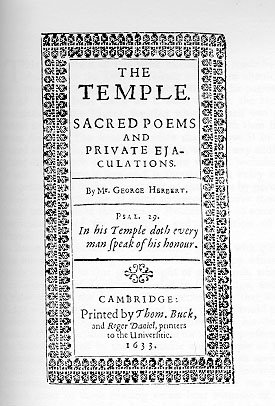
If you have been following my blog, you will know that I am reading 16th C English poet George Herbert’s masterpiece, The Temple, a collection of pious poems on various and sundry topics. I recently came across this beautiful poem on prayer. May it encourage you to be a man or woman of prayer.


Prayer

Prayer the Church's banquet, Angels' age,

God's breath in man returning to his birth,
The soul in paraphrase, heart in pilgrimage,
The Christian plummet sounding heav'n and earth;

Engine against th' Almighty, sinners' tower,
Reverséd thunder, Christ-side-piercing spear,
The six-days world transposing in an hour,
A kind of tune, which all things hear and fear;

Softness, and peace, and joy, and love, and bliss,
Exalted Manna, gladness of the best,
Heaven in ordinary, man well dressed,
The Milky way, the bird of Paradise,

Church-bells beyond the stars heard, the soul's blood,
The land of spices; something understood.

Sunday, April 30, 2006

Poetry in the Pulpit


This morning Pastor Kirk Wellum, the pastor of my church (Pilgrim Baptist Fellowship), drew our attention to the lyrics of one of the Church’s most beautiful hymns, “The Love of God” by Frederick M. Lehman. He recited the third stanza to us during his sermon:


Could we with ink the ocean fill, And were the skies of parchment made,
Were every stalk on earth a quill, And every man a scribe by trade,
To write the love of God above Would drain the ocean dry;
Nor could the scroll contain the whole, Tho stretched from sky to sky.

I have sung this hymn many times and I have heard many ministers recite these lines, but it never ceases to move my soul. How powerful these words are, not simply because of poetic potency, but because they words are immensely true. “O love of God how rich and pure! How measureless and strong! It shall forever more endure. The saint's and angels song!”

For the complete lyrics, music and background info, click here.


Tuesday, April 25, 2006

George Herbert's "The Sacrifice"

One of the top ten books that C.S. Lewis considered to be the most influential in his life was The Temple, a book of poetry by the 16th Century poet, George Herbert. I am reading this book, and I recently came across a poem entitled, “The Sacrifice.” It tells the story of the cross from Jesus’ perspective. Herbert repeats the structure and the line “Was ever grief like mine?” after each stanza. I was greatly moved. I am reminded again how powerful poetry can be, how powerful the imagination is when kindled and set ablaze by poetic language. This is especially true when the poet chooses to retell the greatest story in the history of the world. I will write more on imagination later. I have included the first stanza.

The Sacrifice

OH all ye, who passe by, whose eyes and minde

To worldly things are sharp, but to me blinde;
To me, who took eyes that I might you finde:


Was ever grief like mine?

For the rest of the poem as well as a modern version of “The Sacrifice” then click here.

Wednesday, April 12, 2006

Galumphing is a VERB

colloquial: To stride along triumphantly
Etymology: 19c: coined by Lewis Carroll

"With a leap he stood upright and began to walk; and he entered the temple with them, walking and leaping and praising God." Acts 3:8

...some might even say "galumphing and praising God."

Here's the crazy poem that inspired it all... or at least, inspired me to call my blog "Galumphing".

"Jabberwocky" by Lewis Carroll

'Twas brillig, and the slithy toves
Did gyre and gimble in the wabe;
All mimsy were the borogoves,
And the mome raths outgrabe.
'Beware the Jabberwock, my son!
The jaws that bite, the claws that catch!
Beware the Jubjub bird, and shun
The frumious Bandersnatch!'
He took his vorpal sword in hand:
Long time the manxome foe he sought--
So rested he by the Tumtum tree,
And stood awhile in thought.
And as in uffish thought he stood,
The Jabberwock, with eyes of flame,
Came whiffling through the tulgey wood,
And burbled as it came!
One, two! One, two! And through and through
The vorpal blade went snicker-snack!
He left it dead, and with its head
He went galumphing back.
'And hast thou slain the Jabberwock?
Come to my arms, my beamish boy!
O frabjous day! Callooh! Callay!'
He chortled in his joy.
'Twas brillig, and the slithy toves
Did gyre and gimble in the wabe;
All mimsy were the borogoves,
And the mome raths outgrabe.