I think I am teaching myself to be a dinosaur... that is, extinct. I read Virgil and Homer for pleasure, I teach Latin and Classical civilization courses, and I am presently embarking on a whirlwind tour of hell, courtesy of Dante.
C.S. Lewis, in his inaugural speech as Chair of Medieval and Renaissance Literature at Cambridge university, called himself a "dinosaur". What he meant by that was he considered himself to be a rare breed of man, the classically educated man, the man of letters, a true product of Western civilization as it once was. I am not a dinosaur in that sense, nor will I ever be. I am a product of "New Western civilization" whether I like it or not. I did not grow up with tales of heroes and monsters, but rather with Sesame Street, Mr. Rogers, and Loony Tunes. In the late 1950s, C.S. Lewis already considered the world a totally different place than the world he grew up in. Nevertheless, I persist in my attempts to "repair the ruins" of a long, lost culture and civilization. But I wonder if I am like a Roman studying Cicero or Ovid while barbarians are at the gate. Am I training myself for a civilization that no longer exists or can no longer exist? There are no time machines.
Although my goals as an educator and as a student of literature, history, and philosophy are no longer considered relevant in a world steeped in ignorance, self-centredness, and apathy, my only hope is the fact that I am a Christian. Christianity is the one and only perfectly universal truth in the universe. I am not talking about "cultural or social Christianity" but Christianity itself. Christianity is trans-temporal, trans-cultural, trans-denominational, trans-everything. Cultural or social Christianity, which can be quite a different thing, has been imported, sometimes imposed (intentionally or unintentionally) on cultures by varying military, colonial, political, and missionary efforts throughout history. When I distinguish "Christianity" as unique, I am referring to when the Gospel of Jesus Christ truly takes hold of someone, powerfully and transformatively. A Christian is someone who has become catholic in the universal sense... a follower of Christ, the God-Man---not just Christian ideas---but the person of Christ. We become part of the everlasting, eternal, and living body of Christ.
So, I may be training myself to be dinosaur-like in terms of literature and philosophy and education. As a teacher, I may become extinct... replaced by a website or a podcast or nothing at all. Although the sun is setting on Western civilization, I will not despair. Christ is my only hope. He should always be my ultimate and only hope. Perhaps the demise of Old Western civilization is, in part, a result of misplaced hope. As beautiful and true and powerful as Homer or Virgil or Dante might be, it can never save a person, much less a civilization. If we did recover the "Lost Tools of Learning" as Dorothy Sayers calls it, we will only produce "clever devils", as Lewis puts it.
Showing posts with label Teaching. Show all posts
Showing posts with label Teaching. Show all posts
Thursday, December 02, 2010


Tuesday, March 23, 2010
Why we educate...
"They [universities] are not intended to teach the knowledge required to fit men for some special mode of gaining a livelihood. Their object is not to make skilful lawyers or physicians, but capable and cultivated human beings… Education makes a man a more intelligent shoemaker, but not by teaching him how to make shoes."
– John Stuart Mills discussing the purpose of universities when becoming the rector of St. Andrews University in 1867
(Quote liftted from New Saint Andrews College)
Tuesday, February 02, 2010
So political...
I recently gave my Classical civilization students a test on Greek philosophy; one of the questions asked, “What does Aristotle mean by the statement, ‘Man by nature is a political animal’”? Answers varied from humans are “aggressive,” “animalistic,” and “survival of the fittest,” to humans are “conniving” and “deceptive”… Thanks to Darwin, democracy, and Spirit of the West, words like “animal” and “political” have far-reaching connotations these days!
What Aristotle really meant is that humans are communal in nature; we are inter-dependent. Personal isolation, according to Aristotle, cannot lead to happiness or fulfilment. This social dimension to our existence necessitates an ordered and governed society. For Aristotle, “good government” should make possible and enable its citizens to pursue lives well-lived, both as individuals and as a collective society.
Now, everything is so political.
What Aristotle really meant is that humans are communal in nature; we are inter-dependent. Personal isolation, according to Aristotle, cannot lead to happiness or fulfilment. This social dimension to our existence necessitates an ordered and governed society. For Aristotle, “good government” should make possible and enable its citizens to pursue lives well-lived, both as individuals and as a collective society.
Now, everything is so political.
Wednesday, January 27, 2010
How democracy is killing education
We are post-Cold War, so it is safe to criticise the impact democratic principles have had on various aspects of our culture. I am not a Marxist, nor am I a proponent of any other form of government. To quote Winston Churchill, "democracy is the worst form of government... except all the others..." Democracy is good, but it is not a cure-all.
A few months ago, I read an essay by George Parkin Grant, where he criticized the impact of John Dewey on education. Dewey mandated a homogenization of democracy and education. His ideas laid the foundation for educational philosophy and pedagogy, ideas that have dominated public schools across the continent. George Grant, however, notes that democracy and education are incongruous. In order to provide “education for all” you must operate on a common ground, a common denominator…So, he argues, you end up with the “lowest common denominator”.
Education, however, is about challenging students to higher understanding and garnering the best results from the collective human intellect. One outcome of education is that some individuals will rise above their peers. Not everyone who makes it to “base camp” reaches the summit of Mount Everest. But such a view can be construed as educational elitism, which is not very democratic at all. On a colloquial level, teachers, students, universities and colleges, and employers, all complain about “lowered standards” and the “dumbing down” of curriculum. Articles circulate about our general lack of knowledge, our decreasing vocabulary and limited grammar knowledge, our collective stupidity, and our hubristic stubbornness in rejecting any remedy for these problems. We have “successfully” regressed to the lowest common denominator. We have brought the summit of Everest to base camp. By lowering standards and by removing obstacles, we bolster up some students while we “handicap” others… So long as everyone is either “raised” or “lowered” to the same point, then democracy and equality have prevailed.
Like the boys from Golding’s Lord of the Flies, we assume that democracy “vincit omnia”. In truth, democracy doesn’t conquer all; democracy is only as good as the people who are voting. Admittedly, democracy does work, albeit imperfectly, in the North American political landscape. Does it work in Iraq? Does is work in Afghanistan? Eventually it might. If the people rule, then the people need to know how to rule… hence, the natural pairing of democracy and education. But what has happened in North America has gone beyond “pairing”; democracy and education have been blended and education has been diluted.
The Classical Greek city-state, Athens, was the birthplace of democracy, a democracy that inevitably failed. Democracy failed for a number of reasons, many of which had nothing to do with democratic principles. For example, the experimental and innovative climate of Athens, the intellectual climate that produced democracy, was also a very unstable one. Democracy without “checks and balances” is also very unstable. Nevertheless, the “invention” of political democracy---even in its most rudimentary form in the 5th century BC---is an incredible contribution to Western civilization; but, the failure of that democracy should also be weighed. The politicking and spin-doctoring that plague our current political culture were also plaguing Athens’ political climate. At times, Athens degenerated into legalized mob rule; they democratically sentenced Socrates to death! Socrates! They voted for the foolish and flawed Sicilian campaign during the Peloponnesian war. Politically, they were unified. Naysayers were ostracised or sentenced to death. The lofty ideals that gave birth to democracy were displaced by the lowest common denominator, what they all could agree on.
To unite education and democracy on a philosophical level means the death of one or both. If Socrates---the paragon of teachers, the one who debated, asked pressing questions, challenged the status quo and sought for greater understanding---was rejected by democracy, then why would we think a democratized education could survive?

A few months ago, I read an essay by George Parkin Grant, where he criticized the impact of John Dewey on education. Dewey mandated a homogenization of democracy and education. His ideas laid the foundation for educational philosophy and pedagogy, ideas that have dominated public schools across the continent. George Grant, however, notes that democracy and education are incongruous. In order to provide “education for all” you must operate on a common ground, a common denominator…So, he argues, you end up with the “lowest common denominator”.
Education, however, is about challenging students to higher understanding and garnering the best results from the collective human intellect. One outcome of education is that some individuals will rise above their peers. Not everyone who makes it to “base camp” reaches the summit of Mount Everest. But such a view can be construed as educational elitism, which is not very democratic at all. On a colloquial level, teachers, students, universities and colleges, and employers, all complain about “lowered standards” and the “dumbing down” of curriculum. Articles circulate about our general lack of knowledge, our decreasing vocabulary and limited grammar knowledge, our collective stupidity, and our hubristic stubbornness in rejecting any remedy for these problems. We have “successfully” regressed to the lowest common denominator. We have brought the summit of Everest to base camp. By lowering standards and by removing obstacles, we bolster up some students while we “handicap” others… So long as everyone is either “raised” or “lowered” to the same point, then democracy and equality have prevailed.
Like the boys from Golding’s Lord of the Flies, we assume that democracy “vincit omnia”. In truth, democracy doesn’t conquer all; democracy is only as good as the people who are voting. Admittedly, democracy does work, albeit imperfectly, in the North American political landscape. Does it work in Iraq? Does is work in Afghanistan? Eventually it might. If the people rule, then the people need to know how to rule… hence, the natural pairing of democracy and education. But what has happened in North America has gone beyond “pairing”; democracy and education have been blended and education has been diluted.
The Classical Greek city-state, Athens, was the birthplace of democracy, a democracy that inevitably failed. Democracy failed for a number of reasons, many of which had nothing to do with democratic principles. For example, the experimental and innovative climate of Athens, the intellectual climate that produced democracy, was also a very unstable one. Democracy without “checks and balances” is also very unstable. Nevertheless, the “invention” of political democracy---even in its most rudimentary form in the 5th century BC---is an incredible contribution to Western civilization; but, the failure of that democracy should also be weighed. The politicking and spin-doctoring that plague our current political culture were also plaguing Athens’ political climate. At times, Athens degenerated into legalized mob rule; they democratically sentenced Socrates to death! Socrates! They voted for the foolish and flawed Sicilian campaign during the Peloponnesian war. Politically, they were unified. Naysayers were ostracised or sentenced to death. The lofty ideals that gave birth to democracy were displaced by the lowest common denominator, what they all could agree on.
To unite education and democracy on a philosophical level means the death of one or both. If Socrates---the paragon of teachers, the one who debated, asked pressing questions, challenged the status quo and sought for greater understanding---was rejected by democracy, then why would we think a democratized education could survive?
Monday, October 05, 2009
Autumn in Algonquin
I spent the weekend canoe tripping in Algonquin with students from my school. It was cold and rainy, but the autumn colours were glorious.


Tuesday, September 29, 2009
Little Women... Big Musical
 Rehearsals are now underway for my school's holiday musical extravaganza, Little Women, based on the novel by Louisa May Alcott (1832–1888). I am directing a stellar cast of talented young women and young men, and I am working with a very gifted director of music. This is my second foray into the world of directing musicals (my first experience was in 2008 directing The Sound of Music). I use the word "foray" because I feel like I am entering someone else's territory and taking spoils. When I was a high school student, I was never involved with the theatre productions at my school. Of course, they used to put on plays like Oedipus Rex and Flowers for Algernon... 'Nuff said.
Little Women The Musical is a fairly new Broadway production, premiering in 2005. The musical, however, is solidly rooted in the classic story by Alcott. The script also appropriately balances drama and humour and the musical numbers are surprisingly delightful. I am surprised because "21st century" and "delightful" rarely go together. Yet, every time I get fed up with the tidal wave of ugly art and post-modern doggerel flooding the creative world, I am pleasantly startled by something beautiful and good. Unfortunately, I find these occasional "roses among thorns" almost exclusively in popular media... e.g., musicals and Hollywood films. Perhaps there is hope in the masses, people made in the image of God, who still prefer truth, beauty and goodness.
This musical is by no means deep or profound; no musical ever is deep or profound. But it is not shallow and meaningless either, which is often the case with the high art one might see at the Toronto Film Festival. So, what is it? It IS delightful.
Wednesday, September 23, 2009
The Great Conversation blogspot
I have launched a "commonplace blog" for one of the courses I teach. The blog is called The Great Conversation. The course I teach is Classical Civilization, a senior course focusing on the literature, philosophy, culture and history of the Greco-Roman world.
A commonplace blog and a Well Educated Mind
My students are collecting from their readings any interesting, pithy, thought-provoking quotations/excerpts and posting them to the blog. Some posts are simple quotations; some posts will include commentary, analysis and reflection. My hope is that my students will do more than "read" the assigned texts; my hope is that they will take in, interact with and learn from the texts we are studying.
The idea to create a "commonplace blog" came from reading The Well Educated Mind by Susan Wise Bauer (2003). In the book, Bauer writes about commonplace books, books where readers would gather and collect quotations from what they were reading. It serves as a record of some one's intellectual journey through collected passages from his readings. Below is an explanation of the origin and methods of keeping commonplace books:
“Time was when readers kept commonplace books. Whenever they came across a pithy passage, they copied it into a notebook under an appropriate heading, adding observations made in the course of daily life. Erasmus instructed them how to do it… The practice spread everywhere in early modern England, among ordinary readers as well as famous writers like Francis Bacon, Ben Jonson, John Milton, and John Locke. It involved a special way of taking in the printed word. Unlike modern readers, who follow the flow of a narrative from beginning to end, early modern Englishmen read in fits and starts and jumped from book to book. They broke texts into fragments and assembled them into new patterns by transcribing them in different sections of their notebooks. Then they reread the copies and rearranged the patterns while adding more excerpts. Reading and writing were therefore inseparable activities. They belonged to a continuous effort to make sense of things, for the world was full of signs: you could read your way through it; and by keeping an account of your readings, you made a book of your own, one stamped with your personality. . . . The era of the commonplace book reached its peak in the late Renaissance, although commonplacing as a practice probably began in the twelfth century and remained widespread among the Victorians. It disappeared long before the advent of the sound bite.”
My plan is for the creation of a class set of collected quotations and commentary, posted in the blogsphere. Students will listen in and contribute to the Great Conversation---that is, three millenia of writing, discussion and thinking about the ideas and values that have shaped Classical and Western civilizations. Collectively, we can chart our intellectual growth and changing perspectives as a class.
Blogging adds a public and communal aspect to the commonplace book; students can read and comment on each other's thoughts, positions and opinions. Students are exposed to varying perspectives on the same texts they have also read. Blogging also adds a "published" aspect to writing. Students need to organize their thoughts in a way that can be understood. They are writing for an audience. They must adhere to the conventions of grammar, spelling and vocabulary. This is not always done perfectly... but the students are no longer writing for a mark. They are writing to communicate to other people, in their class and in cyberspace.
A commonplace blog and a Well Educated Mind
My students are collecting from their readings any interesting, pithy, thought-provoking quotations/excerpts and posting them to the blog. Some posts are simple quotations; some posts will include commentary, analysis and reflection. My hope is that my students will do more than "read" the assigned texts; my hope is that they will take in, interact with and learn from the texts we are studying.
The idea to create a "commonplace blog" came from reading The Well Educated Mind by Susan Wise Bauer (2003). In the book, Bauer writes about commonplace books, books where readers would gather and collect quotations from what they were reading. It serves as a record of some one's intellectual journey through collected passages from his readings. Below is an explanation of the origin and methods of keeping commonplace books:
“Time was when readers kept commonplace books. Whenever they came across a pithy passage, they copied it into a notebook under an appropriate heading, adding observations made in the course of daily life. Erasmus instructed them how to do it… The practice spread everywhere in early modern England, among ordinary readers as well as famous writers like Francis Bacon, Ben Jonson, John Milton, and John Locke. It involved a special way of taking in the printed word. Unlike modern readers, who follow the flow of a narrative from beginning to end, early modern Englishmen read in fits and starts and jumped from book to book. They broke texts into fragments and assembled them into new patterns by transcribing them in different sections of their notebooks. Then they reread the copies and rearranged the patterns while adding more excerpts. Reading and writing were therefore inseparable activities. They belonged to a continuous effort to make sense of things, for the world was full of signs: you could read your way through it; and by keeping an account of your readings, you made a book of your own, one stamped with your personality. . . . The era of the commonplace book reached its peak in the late Renaissance, although commonplacing as a practice probably began in the twelfth century and remained widespread among the Victorians. It disappeared long before the advent of the sound bite.”
—Robert Darnton, “Extraordinary Commonplaces,”
The New York Review of Books, December 21, 2000
The New York Review of Books, December 21, 2000
The Great Conversation
My plan is for the creation of a class set of collected quotations and commentary, posted in the blogsphere. Students will listen in and contribute to the Great Conversation---that is, three millenia of writing, discussion and thinking about the ideas and values that have shaped Classical and Western civilizations. Collectively, we can chart our intellectual growth and changing perspectives as a class.
Why Blog?
Blogging adds a public and communal aspect to the commonplace book; students can read and comment on each other's thoughts, positions and opinions. Students are exposed to varying perspectives on the same texts they have also read. Blogging also adds a "published" aspect to writing. Students need to organize their thoughts in a way that can be understood. They are writing for an audience. They must adhere to the conventions of grammar, spelling and vocabulary. This is not always done perfectly... but the students are no longer writing for a mark. They are writing to communicate to other people, in their class and in cyberspace.
Monday, June 08, 2009
George Parkin Grant on Education: Teaching "purpose", teaching "wisdom"
This evening, I briefly paused from grading examination papers, and I picked up a book I recently borrowed from the library. It is a collection of philosophical essays by George Parkin Grant. Here is an excerpt that struck me.
Reason is at first only present in us potentially and not actually. It needs to be developed, and developed by education. Education is seen as the process by which a person comes to think clearly about the proper purposes of human life. (How different this is from our modern technical education which is simply concerned with teaching people how to get on, never teaching them where they are getting to.) In the old theory of education, when a man began to see what was the ultimate purpose of human life, he was said to be wise---to have the virtue of wisdom. Wisdom was then the purpose of education. It was the condition which men reached through reason, as they came to know what were the purposes in human life truly worthy of a rational soul.
George Parkin Grant “Natural Law” Philosophy in the Mass Age, 1959

Thursday, May 14, 2009
Teaching 21st Century Novels
 I just finished a novel that I was previewing as a possible text to teach next year. It is called, Water for Elephants. It is a New York Times best seller and was highly recommended by a number of avid readers. In the past, I have taught The Kite Runner by Khaled Hosseini and Old School by Tobias Wolff. I make a point to include 21st century novels on my reading list for Senior English, but alas, I am often disappointed with the trite, anachronistic, and unauthentic content of post-modern literature. Protagonists are spineless at the beginning, and they remain spineless at the end. They resolve the crisis of their "spinelessness" by simply embracing it. They lack moral fortitude when it comes to the “conventional” morality, but they are stalwart defenders of political correctness. Water for Elephants was no different. The captions on the cover say things like, “I couldn’t put it down for one minute.” I must admit, there were times I couldn’t pick it up… even for a minute. The novel is set during the Great Depression. It begins with a slighty contrived crisis in the life of a young man about to graduate from Veterinary program at Cornell. His parents are suddenly killed in a freak car accident and he is left penniless because the bank---unflinchingly---foreclosed on his entire inheritance. So, he runs off with the circus… (I know… THE CIRCUS…?). In truth, that is the most interesting part. The author researched extensively the American travelling circus in the twenties and thirties. The circus is a fresh and interesting setting, full of possibilities for examining the strange and bizarre behaviour of human beings---both those who go to the circus, and also those who run a circus. Unfortunately, the author fails to develop, with any authenticity, a single believable human being in the story.
The protagonist, Jacob, was a man ahead of his time... Way ahead. In fact, it seemed as though he just entered a Vancouver Star Buck’s and was inadvertently sucked into a trans-temporal worm hole, thrusting him into the previous century. I may have bought into the tribute to post-modern relativism and egalitarianism if I could have seen some growth in the character caused by relevant experiences. The novel begins like a Bildungsroman, but the protagonist never really comes-of-age. His character is static---other than loosing his virginity; he doesn’t really learn anything or change. Even when the novel alternatively flips from the 1920s circus to a 21st century nursing home, we see no real growth in the elderly Jacob compared to the youthful Jacob. And, as a result, the reader experiences no growth either; we are simply served up another helping of the bland post-modern, 21st century tofu and rice cakes we get from media like un-real "reality" TV.
Political correctness seems to be the backbone of the novel. The most glaring anachronism is the fact that the protagonist is innately unprejudiced toward people groups who have been historically discriminated against: women, prostitutes, Jews, short people, stout people, labourers/working class, and so on. No classicism and no prejudice. I am not upset with the values he holds; however, as a reader, I am disappointed with the unjustified presence of late 20th century values. His resolution to adhere to political correctness (while still damning the sinister bourgeois) comes without any catalyst. In contrast, Mark Twain’s novel, The Adventures of Huckleberry Finn, demonstrates the reality of how values are formed; Huck undergoes conflicts between experiences, his conscience and external pressures. Through a series of incidents and personal struggles, Huck eventually overcomes the social and societal prejudices instilled in him and he realises that Jim is truly human being… truly the best of men. In Gruen’s novel, however, the protagonist starts the novel fully acclimatised to modern values. He is an egalitarian who has more in common with the likeminded working class than he has with upper management of the circus. The irony is, of course, he comes from an upper middle class family (his father is a veterinarian) and he attended a veterinary program at Cornell. While rubbing shoulders with the elite at Cornell, in a professional program, with peers who are rich enough to be studying at a prestigious school during a depression… it is unlikely he would be sympathetic to the poor, working class. Yet, lo and behold, when he finally meets poor, working class people, it turns out they are all decent people. Even the “rough” security personnel do their job reluctantly. I also get the impression that Jacob is a feminist (who although tempted to objectify women, resolves—inexplicably in the novel—to treat women with equality and respect); in addition, he is an animal activist, engineer of social welfare and a moral relativist. Very modern indeed. I am surprised Jacob isn’t also a vegetarian who decries the amount of garbage the circus creates. That would be going too far, perhaps. In the ending of the novel, Jacob takes on a very 21st century demeanour when he refuses to grow up (even though he is now 93 years old) and he opts [spoiler] ...to run away with the circus... again.
What I did like about the novel is the vocabulary. Gruen has clearly researched the vernacular of the circus and she uses vivid precision in her diction. At times, though, it seemed she was using a thesaurus too often, when simpler words would do, in an effort to present a high-brow façade to divert the reader’s attention from the contrived storyline: an orphaned veterinarian running off with the circus, falling in love with a show girl who is already married to a mean and nasty man, and ending up adopting a pet elephant, marrying the girl and working at a zoo. I am very surprised the publishers accepted this pitch. A vet, the circus, an elephant and a happy ending… perhaps they were confusing the pitch with a James Harriot novel.
After finishing the novel, I turned back to Homer’s The Iliad to finally draw to a close my reading of this epic poem. It was like going from a lunch of instant microwavable mac ‘n cheese and no-name pizza pops to an evening dinner of steak, baked potatoes, sautéed mushrooms and red wine. Why can’t we write stories like Homer anymore?
Tuesday, April 21, 2009
At L'Abri: Francis Schaeffer on Education
 I recently read an article taken from a speech by Francis Schaeffer where he addresses education. As I read the article, I began to realize how much I have allowed secular humanism to creep through the backdoor of policy and curriculum into my teaching-practice as an educator. The heart of the matter is understanding reality, the reality of our students and the reality of the world our students need to learn about. The clarity with which we understand reality is determined by our worldview. One of the fundamental messages from the works of Schaeffer is that worldview matters. Nowhere is the clash between worldviews more evident than in education.
Christian Education recognizes fallen humanity
The secular approach to education begins with an unreal notion of the human condition of its students. This is why so many teachers at all levels of education are bewildered by student apathy, disrespect, slothfulness and dishonesty. Policy and program is mandated to remove consequence, to encourage egalitarian (and anti-authority) levelings and to molly-coddle students’ emotional whims and self-indulgent habits. I am beginning to sound like a curmudgeon, but I don’t think I am exaggerating. Anecdotal evidence corroborates my assessment. In an article by Margaret Wente from The Globe and Mail (April 18, 2009), she cites a number of professors, principals and teachers with similar observations. She writes “The teacher’s job is no longer to educate them up to a certain standard but to ‘meet their needs.’” At the heart of human sin is self-centredness. Educational policy-makers and curriculum-writers placate this human tendency of our fallen nature to be heliocentric.
The Bible is clear that pride is self-destructive, yet modern education is designed to inflate student ego and self-esteem. Wente laments, “no one has ever given them an accurate assessment of their skills.” She writes, “the biggest problem is the mismatch between students’ abilities and their aspirations.”
Christian Education should be a superior education
In Schaeffer’s speech, he articulates some of the distinct qualities of good education, particularly Christian education. Whether you homeschool or send your children to Christian schools, Schaeffer’s comments apply. He states that Christian education should be more than reactionary to the “materialist view… that rules out a Creator”. Many Christian parents withdraw their children from public education in order to shelter them or protect them from humanistic and secular indoctrination. These are good reasons to seek education for your children elsewhere, but the alternative needs to be more than an intransigent rejection of public education. Schaeffer writes, “[Christian education] should be a superior education, if you are going to really protect the Christian school. It should certainly teach the students how to read and write and how to do mathematics better than most public schools enjoy today.” The end result of Christian education should be truly intelligent, well-trained and intellectually challenged graduates. Why? For the glory of the Creator. The Head Master of Bradford Academy, a classical Christian school in North Carolina, writes “We believe the glory of God encompasses all of life and how we live it. We want our students to live and think about life in such a way that God is glorified in all things.” (Johnston)
Christian Education should address all human knowledge
Schaeffer continues, “Christian education should produce students more educated in the totality of knowledge, culture and life, than non-Christian education rooted in a false view of truth. The Christian education should end with a better educated boy and girl and man and woman, than the false could ever produce.” For Schaeffer, Christian education means that students learn to appreciate and learn about “the full scope of human learning.” This includes the arts and humanities, which has recently fallen out of favour in modern approaches to education, including Christian education. Art, music and literature doesn’t seem to have a place in Christian learning. But Schaeffer forces argues the opposite. “If the Judeo-Christian position is the truth of all reality, and-it is, then all the disciplines, and very much including a knowledge of, and I would repeat, an appreciation of, the humanities and the arts are a part of Christian education. Some Christians seem absolutely blind at this point.”
Teaching about the Christian faith should not be compartmentalized from all other aspects of student learning. I have learned this from Schaeffer as well. The Lordship of Christ covers all areas of life.
Total Truth and the Educated Person
Schaeffer gives an imperative for educators to expose our students to “the framework or total truth, rooted in the Creator's existence and in the Bible's teaching, so that in each step of the formal learning process the student will understand what is true and what is false and why it is true or false.” Education in this country will never improve until it reconciles itself to the reality of the Creator.
"Is life dull? How can it be dull? No, a true education, a Christian education, is more than the negative, though that is there. It is giving the tools in the opening the doors to all human knowledge, in the Christian framework so they will know what is truth and what is untruth, so they can keep learning as long as they live, and they can enjoy, they can really enjoy, the whole wrestling through field after field of knowledge. That is what an educated person is."
Francis A. Schaeffer
Sources:
Johnston, Jeffrey S. “For What Purpose?” Nuntias Vol. 4 Issue 1, Mebane: Bradford Academy, Winter 2009. http://bradfordacademy.org/about/newsletters.html
Schaeffer, Francis. “On Education” Excerpt from “Priorities 1982”, two speeches given at the L'Abri Mini-Seminars in 1982. http://www.gbt.org/text/f.html
Wente, Margaret. “We pretend to teach ‘em, they pretend to learn” April 18, 2009. Toronto: The Globe and Mail. http://www.theglobeandmail.com/servlet/story/RTGAM.20090417.wcowent18/BNStory/specialComment/home
Schaeffer, Francis. “On Education” Excerpt from “Priorities 1982”, two speeches given at the L'Abri Mini-Seminars in 1982. http://www.gbt.org/text/f.html
Wente, Margaret. “We pretend to teach ‘em, they pretend to learn” April 18, 2009. Toronto: The Globe and Mail. http://www.theglobeandmail.com/servlet/story/RTGAM.20090417.wcowent18/BNStory/specialComment/home
Monday, April 13, 2009
Satchel, shoulder bag, man-purse?
During spring break, I spent 12 days leading a small group of my students around Great Britain. Consequently, as the lead teacher, I was required to carry a considerable amount of paperwork---medical records, contact information, emergency protocol policies, etc. To facilitate this perpetual lugging of a preponderance of paperwork, I brought along a satchel. Almost immediately my fashion-conscious youth commented on my “man-purse.” To nip this in the bud, I directed their attention to the paragon of masculinity… Indiana Jones. Does Indy carry a “man-purse” or a satchel? ‘Nuff said.

Indiana Jer and the Satchel of Manhood: Stonehenge, England
Tuesday, April 07, 2009
Why do students hate poetry?
Why do students hate poetry? One of the main reasons students dislike poetry, I suggest, is because students have been trained to look for “story” in all the literary works they encounter. Overemphasis on story is evident in the sort of literature students are asked to study.
The bulk of teacher-sanctioned classroom reading material is narrative.
Novels, movies, short stories and graphic novels provide clear, discernible plots for our students to find; poetry offers them a sublime experience that is discernible only after a concerted effort on the part of the reader.
This overexposure to narrative fiction, coupled with the fact that we live in a time when entertainment and information come in flashy, overly explicit and simplified forms, results in our students' aversion to the seemingly "dull", implicit and complicated forms of poetic expression.
Why we should emphasize POETRY instead of PROSE
Human beings have a natural affinity for story; we tell stories, we enjoying hearing and watching stories and we understand our lives in terms of story. Literary education has capitalized on this natural love of story in order to foster student interest. This is not necessarily a bad thing. However, teaching “story” has been over-emphasized. Whether in the form of comic books, graphic novels, plays, movies, short stories or novels, “story” has been the backbone of English education.
The consequence is that students now expect to find plot is almost every piece of creative writing they encounter. When poetry is taught, many teachers choose to teach ballads or narrative poetry. Even in narrative poetry, however, “plot development” is rarely the raison d'être. As a result, when a student encounters a lyric poem, or if the narrative is veiled or vague, he throws up his arms in despair: “pointless”—“I don’t get it”—“stupid”—in other words, the student is impatient for clear meaning because that is what he has been taught to look for.
Certainly great literature is more than “plot”; however, many students miss the “poetic” aspects of prose because they can easily and effortlessly understand the story. Since that is what they are used to look for, they often stop there. I have heard many English teachers complain that students provide “plot summary” instead of analysis. Understanding plot is the effortless part of reading prose fiction. A good story teller should be able to clearly convey plot! When a student is asked to find the “deeper” meaning of a novel or short story, they are really being asked to understand the poetic meaning. The symbols, extended metaphors, allusions, imagery, etc. of a novel are the poetic elements. This is, I argue, the heart of literary exploration. Reading plot summaries is not reading literature. Reading and understanding the poetry within the prose is what true literary reading is all about. Plot can be a distraction to poetic understanding. Therefore, in early years, we should begin teaching students more poetry and less prose. We should also emphasize poetry in our curriculum from K-12. Poetry is the gateway to understanding all other forms of literature.
Why we should emphasize POETRY instead of PROSE
Human beings have a natural affinity for story; we tell stories, we enjoying hearing and watching stories and we understand our lives in terms of story. Literary education has capitalized on this natural love of story in order to foster student interest. This is not necessarily a bad thing. However, teaching “story” has been over-emphasized. Whether in the form of comic books, graphic novels, plays, movies, short stories or novels, “story” has been the backbone of English education.
The consequence is that students now expect to find plot is almost every piece of creative writing they encounter. When poetry is taught, many teachers choose to teach ballads or narrative poetry. Even in narrative poetry, however, “plot development” is rarely the raison d'être. As a result, when a student encounters a lyric poem, or if the narrative is veiled or vague, he throws up his arms in despair: “pointless”—“I don’t get it”—“stupid”—in other words, the student is impatient for clear meaning because that is what he has been taught to look for.
Certainly great literature is more than “plot”; however, many students miss the “poetic” aspects of prose because they can easily and effortlessly understand the story. Since that is what they are used to look for, they often stop there. I have heard many English teachers complain that students provide “plot summary” instead of analysis. Understanding plot is the effortless part of reading prose fiction. A good story teller should be able to clearly convey plot! When a student is asked to find the “deeper” meaning of a novel or short story, they are really being asked to understand the poetic meaning. The symbols, extended metaphors, allusions, imagery, etc. of a novel are the poetic elements. This is, I argue, the heart of literary exploration. Reading plot summaries is not reading literature. Reading and understanding the poetry within the prose is what true literary reading is all about. Plot can be a distraction to poetic understanding. Therefore, in early years, we should begin teaching students more poetry and less prose. We should also emphasize poetry in our curriculum from K-12. Poetry is the gateway to understanding all other forms of literature.
Tuesday, November 18, 2008
At the Kilns: Letters to an American Lady, grading papers and rediscovering Horatio
One of the things I have learned while reading C.S. Lewis is that grading papers is always a burden, no matter how much of a genius or master teacher one is. Perhaps, it is more of a burden for those who are geniuses and master teachers…
This point became clear after reading a short little book called Letters to an American Lady. It is a collection of letters C.S. Lewis wrote to an American woman over the course of a decade. She wrote to Lewis---at times incessantly---and Lewis responded faithfully to almost every single letter she wrote to him. During the course of years, academic terms and increasing illness on both their parts, Lewis recounts the demands on his time. Most prominent is grading papers.
I was encouraged, not by the fact that Lewis felt burdened by grading, but that I was not the only one who seemed to be feeling the pangs of poorly written prose. There is no easy way out of marking. It simply has to be waded through. During each stint of examinations, Lewis faithful trudged on despite his time being far more precious and valuable than mine. The other encouraging thing for me is that since Lewis inevitably finishes grading and is able to move on to other things he enjoys, so can I.
All this being said, I recently read a student essay that brought me some delight. I am currently wading through 80 essays on Hamlet… and I have encountered the usual themes of death, revenge and death-resulting-from-revenge and death-resulting-in-revenge sort of essays… This essay stood out because it focused on Horatio. My student writes, “readers have a tendency to direct much of their energy towards the main characters. However, secondary characters in a work should never be overlooked…” True enough. He goes on to write, “In a play full of deception, betrayal, revenge and strong passion, it is very important for the audience to be able to rely on a voice of reason and truth.” Very true. He continues, “In Hamlet, Horatio is this truth teller; he is an observer of action and a commentator. Horatio is the one character in the play who can be trusted not only by Hamlet but by the audience.” I was gripped. In teaching Hamlet, I address Horatio’s importance only in relation to how he functions in advancing the plot shedding certain light on Hamlet. I had never really considered Horatio for Horatio’s sake. When all other human beings in the play betray all forms of human relationships, Horatio is the steadfast and faithful one. He is the hope that remains after Pandora’s Box is opened and a torrent of death and mayhem are unleashed in the closing scene of the play.
Anyway, it was great to read something inspiring. Although it is making the rest of my marking more challenging. Revenge and death, death and revenge. Oh, the carnage of words, paper and Shakespeare. As I tread through the battlefields of intellectual promise and academic potential, I long for a truth teller, someone who can be trusted… I need another dose of Horatio.
This point became clear after reading a short little book called Letters to an American Lady. It is a collection of letters C.S. Lewis wrote to an American woman over the course of a decade. She wrote to Lewis---at times incessantly---and Lewis responded faithfully to almost every single letter she wrote to him. During the course of years, academic terms and increasing illness on both their parts, Lewis recounts the demands on his time. Most prominent is grading papers.
I was encouraged, not by the fact that Lewis felt burdened by grading, but that I was not the only one who seemed to be feeling the pangs of poorly written prose. There is no easy way out of marking. It simply has to be waded through. During each stint of examinations, Lewis faithful trudged on despite his time being far more precious and valuable than mine. The other encouraging thing for me is that since Lewis inevitably finishes grading and is able to move on to other things he enjoys, so can I.
All this being said, I recently read a student essay that brought me some delight. I am currently wading through 80 essays on Hamlet… and I have encountered the usual themes of death, revenge and death-resulting-from-revenge and death-resulting-in-revenge sort of essays… This essay stood out because it focused on Horatio. My student writes, “readers have a tendency to direct much of their energy towards the main characters. However, secondary characters in a work should never be overlooked…” True enough. He goes on to write, “In a play full of deception, betrayal, revenge and strong passion, it is very important for the audience to be able to rely on a voice of reason and truth.” Very true. He continues, “In Hamlet, Horatio is this truth teller; he is an observer of action and a commentator. Horatio is the one character in the play who can be trusted not only by Hamlet but by the audience.” I was gripped. In teaching Hamlet, I address Horatio’s importance only in relation to how he functions in advancing the plot shedding certain light on Hamlet. I had never really considered Horatio for Horatio’s sake. When all other human beings in the play betray all forms of human relationships, Horatio is the steadfast and faithful one. He is the hope that remains after Pandora’s Box is opened and a torrent of death and mayhem are unleashed in the closing scene of the play.
Anyway, it was great to read something inspiring. Although it is making the rest of my marking more challenging. Revenge and death, death and revenge. Oh, the carnage of words, paper and Shakespeare. As I tread through the battlefields of intellectual promise and academic potential, I long for a truth teller, someone who can be trusted… I need another dose of Horatio.
Monday, August 25, 2008
Teaching Shakespeare as Literature
Shakespeare originally wrote his plays to be performed before a mostly uneducated and illiterate audience. Writing plays was Shakespeare’s “job”---he earned a modest living from writing and producing plays. He was not writing for “art’s sake” but for “food’s sake”. The old adage, “necessity is the father of invention” is particularly true in Shakespeare’s case. The point here is that Shakespeare’s plays were written to be performed on stage. Most of his plays did not appear in print until well after his death. For this reason, many gurus of education are arguing for a performance-based approach to teaching Shakespeare. If the plays were written for the stage, then they should be taught on a “stage”.
 Peggy O’Brien from the Folger Library (one of the largest and most significant Shakespeare research centre in the world) writes, “Performing a Shakespearean scene or scenes is the single most important part of a student’s Shakespeare education. Period.” She may be right, but there is too much pressure on educators to use Shakespeare primarily as a drama unit rather than literature unit. The dramatic aspect of Shakespeare lends itself well to a performance-based approach. However, his plays run deep, much deeper than the average audience-goer would understand. This is the reason why Shakespeare can be, and should be, taught as literature. A student’s exposure to Shakespeare needs to be more than simply “working towards performance”.
Had Shakespeare been writing three hundred years later than his own time in history, he may have chosen to write novels as opposed to plays. His characters have a psychological complexity and depth that surpass most theatrical characters in Elizabethan drama; some of his characters are unsurpassed by present-day drama. Essentially, Shakespeare wrote his plays “deeper” than required for successful stage performance. In fact, I argue that some of Shakespeare’s plays “read” better than they are “performed”. So much of the “drama” in the play Macbeth, for example, is so internal and psychological that I have rarely watched a great on-stage performance of it (no fault to the performers or directors). It is a play, I believe, that is better read than watched. In some ways, Shakespeare is like a novelist trapped in a playwright’s body.
That being said, Shakespeare still works well on stage. The plays were as popular in Elizabethan England (for the most part) as they are now (if not more so). However, I find that my enjoyment of “Shakespeare performed” is different from “Shakespeare read”. Sometimes, my enjoyment of Shakespeare performed is, in part, due to the fact that I have read the play beforehand. As educators, it is important that we expose our students to both performance enjoyment and the enjoyment of a close reading. Why did Shakespeare include so much symbolism and metaphor in his plays, when so much of it would be lost on his audiences? Perhaps there is a bit of “art for art’s sake” in Shakespeare after all.
 Peggy O’Brien from the Folger Library (one of the largest and most significant Shakespeare research centre in the world) writes, “Performing a Shakespearean scene or scenes is the single most important part of a student’s Shakespeare education. Period.” She may be right, but there is too much pressure on educators to use Shakespeare primarily as a drama unit rather than literature unit. The dramatic aspect of Shakespeare lends itself well to a performance-based approach. However, his plays run deep, much deeper than the average audience-goer would understand. This is the reason why Shakespeare can be, and should be, taught as literature. A student’s exposure to Shakespeare needs to be more than simply “working towards performance”.
Had Shakespeare been writing three hundred years later than his own time in history, he may have chosen to write novels as opposed to plays. His characters have a psychological complexity and depth that surpass most theatrical characters in Elizabethan drama; some of his characters are unsurpassed by present-day drama. Essentially, Shakespeare wrote his plays “deeper” than required for successful stage performance. In fact, I argue that some of Shakespeare’s plays “read” better than they are “performed”. So much of the “drama” in the play Macbeth, for example, is so internal and psychological that I have rarely watched a great on-stage performance of it (no fault to the performers or directors). It is a play, I believe, that is better read than watched. In some ways, Shakespeare is like a novelist trapped in a playwright’s body.
That being said, Shakespeare still works well on stage. The plays were as popular in Elizabethan England (for the most part) as they are now (if not more so). However, I find that my enjoyment of “Shakespeare performed” is different from “Shakespeare read”. Sometimes, my enjoyment of Shakespeare performed is, in part, due to the fact that I have read the play beforehand. As educators, it is important that we expose our students to both performance enjoyment and the enjoyment of a close reading. Why did Shakespeare include so much symbolism and metaphor in his plays, when so much of it would be lost on his audiences? Perhaps there is a bit of “art for art’s sake” in Shakespeare after all.
Saturday, August 23, 2008
Three Days with the Bard
 This week I was in Stratford (Ontario) attending a teacher conference at the Shakespeare Festival. The Stratford Shakespeare Festival is considered by theatre aficionados as North America’s premiere classical theatre. But, as they say, familiarity breeds contempt. While I was a student at the University of Western Ontario in London (ON), I took full advantage of the student rate ($20 at the time), and I saw numerous plays at the Festival. Now as a teacher, I catch a play or two every year with my students. I began to take the theatre for granted. I live and work next door to Stratford. This attitude of ingratitude, however, has changed this week for two reasons.
The first reason was the opportunity I had to work with teachers who came from places as far as Rochester NY, North Bay and New Brunswick! These teachers were thrilled to be in Stratford. I saw Stratford through their eyes. Would I drive six or eight hours to catch a Stratford play? Would I fly from New Brunswick? A different perspective on what you “have” makes all the difference.
The second reason was the fact that I really enjoyed the shows I watched this week. Part of the Teachers’ Conference included complimentary tickets to three Shakespearean plays. I also had the opportunity to workshop with some of the actors from the plays, most notably, Adrienne Gould, who plays Ophelia in Hamlet. The plays I saw were Romeo and Juliet, Hamlet and Taming of the Shrew. The best of the plays was Hamlet.
I have watched Hamlet on stage a few times, once previously at Stratford (starring Paul Gross in 2000). This particular stage production of Hamlet was great. Award winning Canadian actor Ben Carlson shines as Hamlet. Gould’s Ophelia is also the best I have seen on stage. I thoroughly enjoyed the performance. I was more than awake; I was engaged. Admittedly, there are odd bits in the production. One strange set piece is a gigantic pool table that miraculously appears after a blackout on stage. It is humongous. What made this especially odd is the fact that this huge table had little purpose. In the Kenneth Branagh film version of Hamlet (1996), there is also a pool table (I think?) in the identical scene. Claudius is---symbolically---a “pool shark”. He manipulates the situation, lures Laertes into his schemes and creates the ultimate set up. The symbol works well in the movie. On stage, the table is simply a colossal distraction---albeit a dazzlingly magnificent piece of furniture. The point is, the actors and the scene are lost behind the gorgeous oak pool table. Another reason making the table odd on-stage was the fact that Laertes, who just tragically lost both his father and his sister, and who almost raised a revolution in Denmark and nearly committed regicide, is in the next scene, playing snooker… In Branagh’s film it seems to work. Claudius is manipulating Laertes, distracting him from his rage. On stage, I couldn’t help but wonder how much that table cost, how did they get it on stage so fast and what are they going to do with it after the show is over?
There was also a piano on stage during the whole production. Although used cleverly throughout the performance, I found it a distraction as well. However, not enough of a distraction to cause me to miss Carlson’s Hamlet. He truly embodied Shakespeare’s most celebrated tragic hero. It was a risky manoeuvre, but Carlson’s and Gould’s performances redeem the show of all its flaws.
So, I appreciate Stratford a little more these days. I am looking forward to bringing my 90 Grade 12 English students to Stratford in order to see Hamlet. I feel confident this performance will not turn my students off the bard. It may do just the opposite. If you are in the neighbourhood, take advantage of Stratford’s Shakespeare Festival.
I have watched Hamlet on stage a few times, once previously at Stratford (starring Paul Gross in 2000). This particular stage production of Hamlet was great. Award winning Canadian actor Ben Carlson shines as Hamlet. Gould’s Ophelia is also the best I have seen on stage. I thoroughly enjoyed the performance. I was more than awake; I was engaged. Admittedly, there are odd bits in the production. One strange set piece is a gigantic pool table that miraculously appears after a blackout on stage. It is humongous. What made this especially odd is the fact that this huge table had little purpose. In the Kenneth Branagh film version of Hamlet (1996), there is also a pool table (I think?) in the identical scene. Claudius is---symbolically---a “pool shark”. He manipulates the situation, lures Laertes into his schemes and creates the ultimate set up. The symbol works well in the movie. On stage, the table is simply a colossal distraction---albeit a dazzlingly magnificent piece of furniture. The point is, the actors and the scene are lost behind the gorgeous oak pool table. Another reason making the table odd on-stage was the fact that Laertes, who just tragically lost both his father and his sister, and who almost raised a revolution in Denmark and nearly committed regicide, is in the next scene, playing snooker… In Branagh’s film it seems to work. Claudius is manipulating Laertes, distracting him from his rage. On stage, I couldn’t help but wonder how much that table cost, how did they get it on stage so fast and what are they going to do with it after the show is over?
There was also a piano on stage during the whole production. Although used cleverly throughout the performance, I found it a distraction as well. However, not enough of a distraction to cause me to miss Carlson’s Hamlet. He truly embodied Shakespeare’s most celebrated tragic hero. It was a risky manoeuvre, but Carlson’s and Gould’s performances redeem the show of all its flaws.
So, I appreciate Stratford a little more these days. I am looking forward to bringing my 90 Grade 12 English students to Stratford in order to see Hamlet. I feel confident this performance will not turn my students off the bard. It may do just the opposite. If you are in the neighbourhood, take advantage of Stratford’s Shakespeare Festival.

Wednesday, July 30, 2008
A kid's odyssey: Homer's The Odyssey for young readers
For two years, I have been teaching Homer’s The Odyssey to Grade 12 Classical Civilization students. My students (those who actually read the epic poem…), are absolutely thrilled by the story. I am thrilled myself. It is a great story. I am planning on teaching it again in the Fall.
Recently, my second son, Nate (7 yrs) also discovered the excitement and thrill of the Odyssey… dangerous voyages, meddling gods and goddesses, escaping an inhospitable Cyclops, outwitting bewitching nymphs, battling self-serving and usurping nobles…
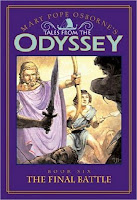 He isn’t reading Homer (per se)… Rather, he is reading a 6-part series of chapter books retelling the famous story. The series, called Tales from The Odyssey, is written by Mary Pope Osborne (the author of the bestselling Magic Tree House series). She retains the bulk of the narrative, including the sordid moments (albeit appropriately diluted for young readers). She also uses the Greek names of gods and goddesses, heroes and monsters and she provides a pronunciation guide at the back of each book.
My son couldn’t put them down. He devoured the books as fast and as ravenously as the six-headed Scylla or the one-eyed Polyphemus devour Odysseus’s men.
Great stories truly stand the test of time. For almost three thousand years, people have been delighted by the adventures of Odysseus and his fated voyage. Thanks to Mary Pope Osborne, the next generation is able to whet their appetite for great---and ancient---storytelling. If you know any Grade 2 students who would love to go on a romping ride of a read, look up Osborne’s Tales for the Odyssey.
NB: For big people interested in The Odyssey, I highly recommend the recent award-winning translation by Robert Fagles. For a great audio version, Ian McKellen, who played Gandalf in Peter Jackson’s recent film adaptation of Lord of the Rings, reads Fagles translation (unabridged) on CD.
Recently, my second son, Nate (7 yrs) also discovered the excitement and thrill of the Odyssey… dangerous voyages, meddling gods and goddesses, escaping an inhospitable Cyclops, outwitting bewitching nymphs, battling self-serving and usurping nobles…
 He isn’t reading Homer (per se)… Rather, he is reading a 6-part series of chapter books retelling the famous story. The series, called Tales from The Odyssey, is written by Mary Pope Osborne (the author of the bestselling Magic Tree House series). She retains the bulk of the narrative, including the sordid moments (albeit appropriately diluted for young readers). She also uses the Greek names of gods and goddesses, heroes and monsters and she provides a pronunciation guide at the back of each book.
My son couldn’t put them down. He devoured the books as fast and as ravenously as the six-headed Scylla or the one-eyed Polyphemus devour Odysseus’s men.
Great stories truly stand the test of time. For almost three thousand years, people have been delighted by the adventures of Odysseus and his fated voyage. Thanks to Mary Pope Osborne, the next generation is able to whet their appetite for great---and ancient---storytelling. If you know any Grade 2 students who would love to go on a romping ride of a read, look up Osborne’s Tales for the Odyssey.
NB: For big people interested in The Odyssey, I highly recommend the recent award-winning translation by Robert Fagles. For a great audio version, Ian McKellen, who played Gandalf in Peter Jackson’s recent film adaptation of Lord of the Rings, reads Fagles translation (unabridged) on CD.
Thursday, July 10, 2008
A Teacher in July...
I am sitting outside in my Muskoka chair… right now… as I write this.
So… I listen to the gentle hum of the air conditioner, as it cools the inside of my house… I am enjoying the sound of the peaceful breeze rustling the leaves of our mighty beech tree and “tinging” and “clinking” of my wife’s wind chimes. I watch as moths and butterflies flutter over my yard and I gaze at the quietly swaying tire-swing. Ah, summer. (It would be a lie to say that this was not the best time of the year to be a teacher.)
I lamented to a friend how the summer is just not long enough... how quickly it goes by...
I was met with sarcasm with a hint of disdain.
So… I listen to the gentle hum of the air conditioner, as it cools the inside of my house… I am enjoying the sound of the peaceful breeze rustling the leaves of our mighty beech tree and “tinging” and “clinking” of my wife’s wind chimes. I watch as moths and butterflies flutter over my yard and I gaze at the quietly swaying tire-swing. Ah, summer. (It would be a lie to say that this was not the best time of the year to be a teacher.)
I lamented to a friend how the summer is just not long enough... how quickly it goes by...
I was met with sarcasm with a hint of disdain.
Friday, June 13, 2008
At the Kilns: The need to be needed
The first of the “four loves” C.S. Lewis writes about in his book The Four Loves is “Affection”. Affection is the broadest and most inclusive of loves, the sort of love between parents and children, teachers and students, masters and pets, so on and so forth. In his discussion of this sort of love, he details the associated pitfalls. And, like all beautiful gifts of God, given to fallen man, there are many pitfalls.
One pitfall in particular struck me. He described the “terrible need to be needed” and he cited, as example, the over-protective mother, who labours to ensure an ever-dependent mindset in her children. Lewis describes the “ravenous need to be needed” that will “gratify itself either by keeping its objects needy or by inventing for them imaginary needs”. This abuse of affection, however, is not limited to mothers. Lewis goes on to cite a literary example from Jane Austen’s Emma. I have not read the book, but I have watched the film version. I recall Emma’s controlling affection for Harriet Smith.
What struck me in all this was not that I am an over-protective mother (or father…) nor am I the sort of sort person who interferes with the happiness of my friends. What struck me was Lewis third example—the teacher. He writes,
One pitfall in particular struck me. He described the “terrible need to be needed” and he cited, as example, the over-protective mother, who labours to ensure an ever-dependent mindset in her children. Lewis describes the “ravenous need to be needed” that will “gratify itself either by keeping its objects needy or by inventing for them imaginary needs”. This abuse of affection, however, is not limited to mothers. Lewis goes on to cite a literary example from Jane Austen’s Emma. I have not read the book, but I have watched the film version. I recall Emma’s controlling affection for Harriet Smith.
What struck me in all this was not that I am an over-protective mother (or father…) nor am I the sort of sort person who interferes with the happiness of my friends. What struck me was Lewis third example—the teacher. He writes,
My own profession—that of a university teacher—is in this way dangerous. If we are any good we must always be working towards the moment at which our pupils are fit to become our critics and rivals. We should be delighted when it arrives, as a fencing master is delighted when his pupil can pink and disarm him.I must confess that—at times—I delight too much in the reciprocated affection from my pupils. I must remind myself that educators “must aim” at making ourselves “superfluous…” It is a stern warning for all educators. C.S. Lewis writes, “The hour when we can say, ‘They need me no longer’ should be our reward”. A truly great reward indeed.
Thursday, June 12, 2008
Why I should retire from teaching (at the ripe old age of 32)

As the school year draws to a close, as exams are graded, marks are calculated, comments and reports are generated... as my students walk across the stage in great pomp and ceremony... I am beginning to plan for next year. What texts will I teach next year? What assignments shall I give? How can I rearrange my classroom to maximize student learning? What is WRONG with me?! I am having a baby (or my wife is having our baby) in a month's time while I... instead of building cribs and doing pre-baby stuff... I am starting to plan my courses for next year! Technically this school year hasn't even finished yet.
I was warned by a veteran teacher that this might happen. Two months vacation in the summer becoming two months of "prep" time... time devoted to the overhauling of courses and preparations for the following academic year. This veteran teacher told me it was time to retire when that happened. So, I am announcing my retirement from teaching. I think my retirement plan will offer a nickle a month until I reach 2059. Then it goes to a dime. In the meantime, I may go into educational consulting and spend my summer planning someone else's upcoming school year.
I was warned by a veteran teacher that this might happen. Two months vacation in the summer becoming two months of "prep" time... time devoted to the overhauling of courses and preparations for the following academic year. This veteran teacher told me it was time to retire when that happened. So, I am announcing my retirement from teaching. I think my retirement plan will offer a nickle a month until I reach 2059. Then it goes to a dime. In the meantime, I may go into educational consulting and spend my summer planning someone else's upcoming school year.
Tuesday, May 20, 2008
It was, like, an awesome speech, actually
 This morning on CBC Radio 2, I heard about the commencement address given by Pulitzer Prize winning author David McCullough to graduates at Boston College. He said, “Please, please do what you can to cure the verbal virus that seems increasingly rampant among your generation.” He cited the “relentless, wearisome use of words,” such as “like,” “awesome” and “actually.”
As an example, McCullough said, “Just imagine if in his inaugural address John F. Kennedy had said, ‘Ask not what your country can, you know, do for you, but what you can, like, do for your country actually.’”
Subscribe to:
Posts (Atom)