Wednesday, June 10, 2009


Monday, June 08, 2009
George Parkin Grant on Education: Teaching "purpose", teaching "wisdom"
This evening, I briefly paused from grading examination papers, and I picked up a book I recently borrowed from the library. It is a collection of philosophical essays by George Parkin Grant. Here is an excerpt that struck me.
Reason is at first only present in us potentially and not actually. It needs to be developed, and developed by education. Education is seen as the process by which a person comes to think clearly about the proper purposes of human life. (How different this is from our modern technical education which is simply concerned with teaching people how to get on, never teaching them where they are getting to.) In the old theory of education, when a man began to see what was the ultimate purpose of human life, he was said to be wise---to have the virtue of wisdom. Wisdom was then the purpose of education. It was the condition which men reached through reason, as they came to know what were the purposes in human life truly worthy of a rational soul.
George Parkin Grant “Natural Law” Philosophy in the Mass Age, 1959

Monday, May 25, 2009
At L'Abri: Mercy for Doubters
He came to understand this reality during the period in Schaeffer’s life that he referred to as the crisis. In 1955, Schaeffer was serving as a missionary while living with his wife and family in Switzerland. He was struck by the incongruity between the power spoken of in the Scriptures the lack of power experienced in his own Christian life. He was also distressed by the seeming impotence of the Christian church in general. Despite the devotion to truth and doctrine, the most disturbing observation Schaeffer made about Christianity was the lack of love shown by many professing believers for each other and for the lost. It seemed to him that intellectual ascent to purity of doctrine did not—by mere default—lead to God honouring lives in practice. Something more is needed. If the Bible is true, then it must be true in reality, not just in the realm of the abstract. The Bible speaks of “power” in the lives of believers, but why was there so little power evident in real life? He spent many months hiking the roads and trails in the Swiss Alps, as well as pacing the upper floor hay loft of his chalet, pondering the reality of Christianity. He returned to a state of agnosticism. Edith was distressed by this, but she prayed fervently for her husband during his time of doubt.
Thankfully he came out of this period of doubt with a deeper understanding of Truth. After reflecting on Christianity, he concluded that it is truth; what he also discovered was the reality of this truth. Christianity is more than doctrine, intellectual suppositions, theological musings… it is reality…. Later in Schaeffer’s ministry, his own experience of honest doubt would make him well suited in addressing---with compassion and love---the doubts of hundreds of Christians and non-Christians who would visit L’Abri. In Jude, Paul writes, “Be merciful to doubters”---this verse encapsulates Schaeffer’s ministry. It calls to mind the way Christ handled Thomas’s doubt---with compassionate but unwavering truth, real truth, truth in space and time, truth in the PRESENT---“Put your finger here; see my hands. Reach out your hand and put it into my side. Stop doubting and believe.” This is how Schaeffer spoke to the doubts of so many people. He compels people to come to terms with the historical, future and present reality of God in the universe. Christianity is not just a philosophy, a moral compass or a collection of “good ideas” to guide us through life. God is real in space and time and His power and presence can be experienced in space and time.
When I pondered the impact Schaeffer had on doubters, I became aware of how little the evangelical church openly addresses doubt. Doubt is certainly something we must overcome, but in order to do so, doubt should not be ignored; doubt must be addressed, prayed about and preached on. It takes faith to address doubt; we need to believe that God will answer doubters. Even though Christians may question their faith, He will not remain silent. The end result is always a deeper faith.
Schaeffer’s thoughts on spirituality materialized in a series of talks centred on the Book of Romans. He shared these reflections with the many visitors who came to L’Abri. Later, he organized the talks into a taped lecture series, and eventually, a published book entitled, True Spirituality. Although this book was published later in his ministry, the ideas in it form the heart of his work and the raison d’etre for L’Abri. For those interested in discovering the writings and thought of Francis Schaeffer, this book is an excellent place to start.
Friday, May 22, 2009
Abortion is still an issue
Thursday, May 14, 2009
Teaching 21st Century Novels
 I just finished a novel that I was previewing as a possible text to teach next year. It is called, Water for Elephants. It is a New York Times best seller and was highly recommended by a number of avid readers. In the past, I have taught The Kite Runner by Khaled Hosseini and Old School by Tobias Wolff. I make a point to include 21st century novels on my reading list for Senior English, but alas, I am often disappointed with the trite, anachronistic, and unauthentic content of post-modern literature. Protagonists are spineless at the beginning, and they remain spineless at the end. They resolve the crisis of their "spinelessness" by simply embracing it. They lack moral fortitude when it comes to the “conventional” morality, but they are stalwart defenders of political correctness. Water for Elephants was no different. The captions on the cover say things like, “I couldn’t put it down for one minute.” I must admit, there were times I couldn’t pick it up… even for a minute. The novel is set during the Great Depression. It begins with a slighty contrived crisis in the life of a young man about to graduate from Veterinary program at Cornell. His parents are suddenly killed in a freak car accident and he is left penniless because the bank---unflinchingly---foreclosed on his entire inheritance. So, he runs off with the circus… (I know… THE CIRCUS…?). In truth, that is the most interesting part. The author researched extensively the American travelling circus in the twenties and thirties. The circus is a fresh and interesting setting, full of possibilities for examining the strange and bizarre behaviour of human beings---both those who go to the circus, and also those who run a circus. Unfortunately, the author fails to develop, with any authenticity, a single believable human being in the story.
The protagonist, Jacob, was a man ahead of his time... Way ahead. In fact, it seemed as though he just entered a Vancouver Star Buck’s and was inadvertently sucked into a trans-temporal worm hole, thrusting him into the previous century. I may have bought into the tribute to post-modern relativism and egalitarianism if I could have seen some growth in the character caused by relevant experiences. The novel begins like a Bildungsroman, but the protagonist never really comes-of-age. His character is static---other than loosing his virginity; he doesn’t really learn anything or change. Even when the novel alternatively flips from the 1920s circus to a 21st century nursing home, we see no real growth in the elderly Jacob compared to the youthful Jacob. And, as a result, the reader experiences no growth either; we are simply served up another helping of the bland post-modern, 21st century tofu and rice cakes we get from media like un-real "reality" TV.
Political correctness seems to be the backbone of the novel. The most glaring anachronism is the fact that the protagonist is innately unprejudiced toward people groups who have been historically discriminated against: women, prostitutes, Jews, short people, stout people, labourers/working class, and so on. No classicism and no prejudice. I am not upset with the values he holds; however, as a reader, I am disappointed with the unjustified presence of late 20th century values. His resolution to adhere to political correctness (while still damning the sinister bourgeois) comes without any catalyst. In contrast, Mark Twain’s novel, The Adventures of Huckleberry Finn, demonstrates the reality of how values are formed; Huck undergoes conflicts between experiences, his conscience and external pressures. Through a series of incidents and personal struggles, Huck eventually overcomes the social and societal prejudices instilled in him and he realises that Jim is truly human being… truly the best of men. In Gruen’s novel, however, the protagonist starts the novel fully acclimatised to modern values. He is an egalitarian who has more in common with the likeminded working class than he has with upper management of the circus. The irony is, of course, he comes from an upper middle class family (his father is a veterinarian) and he attended a veterinary program at Cornell. While rubbing shoulders with the elite at Cornell, in a professional program, with peers who are rich enough to be studying at a prestigious school during a depression… it is unlikely he would be sympathetic to the poor, working class. Yet, lo and behold, when he finally meets poor, working class people, it turns out they are all decent people. Even the “rough” security personnel do their job reluctantly. I also get the impression that Jacob is a feminist (who although tempted to objectify women, resolves—inexplicably in the novel—to treat women with equality and respect); in addition, he is an animal activist, engineer of social welfare and a moral relativist. Very modern indeed. I am surprised Jacob isn’t also a vegetarian who decries the amount of garbage the circus creates. That would be going too far, perhaps. In the ending of the novel, Jacob takes on a very 21st century demeanour when he refuses to grow up (even though he is now 93 years old) and he opts [spoiler] ...to run away with the circus... again.
What I did like about the novel is the vocabulary. Gruen has clearly researched the vernacular of the circus and she uses vivid precision in her diction. At times, though, it seemed she was using a thesaurus too often, when simpler words would do, in an effort to present a high-brow façade to divert the reader’s attention from the contrived storyline: an orphaned veterinarian running off with the circus, falling in love with a show girl who is already married to a mean and nasty man, and ending up adopting a pet elephant, marrying the girl and working at a zoo. I am very surprised the publishers accepted this pitch. A vet, the circus, an elephant and a happy ending… perhaps they were confusing the pitch with a James Harriot novel.
After finishing the novel, I turned back to Homer’s The Iliad to finally draw to a close my reading of this epic poem. It was like going from a lunch of instant microwavable mac ‘n cheese and no-name pizza pops to an evening dinner of steak, baked potatoes, sautéed mushrooms and red wine. Why can’t we write stories like Homer anymore?
Wednesday, May 06, 2009
At L'Abri: Schaeffer for Today
 I recently read Colin Duriez’s biography of Francis Schaeffer (Francis Schaeffer: An Authenitc Life). In the preface he states that his biography is the first comprehension survey of Schaeffer’s life. Providentially, it was published last year, just as I planned to explore the works of Schaeffer.
Many Christians I have spoken with have never heard of Schaeffer; I find this fact bewildering. Granted, I first heard of Schaeffer when I was 18 years old, but it wasn’t until years later that I heard more about Schaeffer during an Apologetics course. The appearance of Duriez’s book is timely, then, in reviving interest in the contributions and thought of Francis Schaeffer. Duriez is already well known among Tolkien and C.S. Lewis fans. Duriez’s biography of Schaeffer will no doubt segue the 21st century reader to Schaeffer’s works, especially for those readers already familiar with Duriez’s contributions on Lewis and Tolkien. There is a need to bridge the gap for many Christians who have not read or heard about Schaeffer. His insights on the state of the world at the end of the 20th century is even more relevant today, as much of his “prophesies” about the coming decline of Western civilization is a striking reality in the 21st century.
His name was first mentioned to me by a Youth Pastor, Calvin Russell, who was giving me some tips on an up-and-coming backpacking tour of Europe I was planning for the fall of 1994. Russell recommended that I stop by L’Abri in Switzerland. As it turned out, I only made it to Geneva during my three month, eleven country tour of the old country. For whatever reason, the Lord did not lead me to L’Abri that year. Now, fifteen years later, I am encountering Schaeffer. The timing couldn’t be better.
I am currently reading True Spirituality. I hope to post a little about Duriez’s biography on Schaeffer and explain why I am starting with True Spirituality.
Tuesday, April 21, 2009
At L'Abri: Francis Schaeffer on Education
 I recently read an article taken from a speech by Francis Schaeffer where he addresses education. As I read the article, I began to realize how much I have allowed secular humanism to creep through the backdoor of policy and curriculum into my teaching-practice as an educator. The heart of the matter is understanding reality, the reality of our students and the reality of the world our students need to learn about. The clarity with which we understand reality is determined by our worldview. One of the fundamental messages from the works of Schaeffer is that worldview matters. Nowhere is the clash between worldviews more evident than in education.
Christian Education recognizes fallen humanity
The secular approach to education begins with an unreal notion of the human condition of its students. This is why so many teachers at all levels of education are bewildered by student apathy, disrespect, slothfulness and dishonesty. Policy and program is mandated to remove consequence, to encourage egalitarian (and anti-authority) levelings and to molly-coddle students’ emotional whims and self-indulgent habits. I am beginning to sound like a curmudgeon, but I don’t think I am exaggerating. Anecdotal evidence corroborates my assessment. In an article by Margaret Wente from The Globe and Mail (April 18, 2009), she cites a number of professors, principals and teachers with similar observations. She writes “The teacher’s job is no longer to educate them up to a certain standard but to ‘meet their needs.’” At the heart of human sin is self-centredness. Educational policy-makers and curriculum-writers placate this human tendency of our fallen nature to be heliocentric.
The Bible is clear that pride is self-destructive, yet modern education is designed to inflate student ego and self-esteem. Wente laments, “no one has ever given them an accurate assessment of their skills.” She writes, “the biggest problem is the mismatch between students’ abilities and their aspirations.”
Christian Education should be a superior education
In Schaeffer’s speech, he articulates some of the distinct qualities of good education, particularly Christian education. Whether you homeschool or send your children to Christian schools, Schaeffer’s comments apply. He states that Christian education should be more than reactionary to the “materialist view… that rules out a Creator”. Many Christian parents withdraw their children from public education in order to shelter them or protect them from humanistic and secular indoctrination. These are good reasons to seek education for your children elsewhere, but the alternative needs to be more than an intransigent rejection of public education. Schaeffer writes, “[Christian education] should be a superior education, if you are going to really protect the Christian school. It should certainly teach the students how to read and write and how to do mathematics better than most public schools enjoy today.” The end result of Christian education should be truly intelligent, well-trained and intellectually challenged graduates. Why? For the glory of the Creator. The Head Master of Bradford Academy, a classical Christian school in North Carolina, writes “We believe the glory of God encompasses all of life and how we live it. We want our students to live and think about life in such a way that God is glorified in all things.” (Johnston)
Christian Education should address all human knowledge
Schaeffer continues, “Christian education should produce students more educated in the totality of knowledge, culture and life, than non-Christian education rooted in a false view of truth. The Christian education should end with a better educated boy and girl and man and woman, than the false could ever produce.” For Schaeffer, Christian education means that students learn to appreciate and learn about “the full scope of human learning.” This includes the arts and humanities, which has recently fallen out of favour in modern approaches to education, including Christian education. Art, music and literature doesn’t seem to have a place in Christian learning. But Schaeffer forces argues the opposite. “If the Judeo-Christian position is the truth of all reality, and-it is, then all the disciplines, and very much including a knowledge of, and I would repeat, an appreciation of, the humanities and the arts are a part of Christian education. Some Christians seem absolutely blind at this point.”
Teaching about the Christian faith should not be compartmentalized from all other aspects of student learning. I have learned this from Schaeffer as well. The Lordship of Christ covers all areas of life.
Total Truth and the Educated Person
"Is life dull? How can it be dull? No, a true education, a Christian education, is more than the negative, though that is there. It is giving the tools in the opening the doors to all human knowledge, in the Christian framework so they will know what is truth and what is untruth, so they can keep learning as long as they live, and they can enjoy, they can really enjoy, the whole wrestling through field after field of knowledge. That is what an educated person is."
Francis A. Schaeffer
Schaeffer, Francis. “On Education” Excerpt from “Priorities 1982”, two speeches given at the L'Abri Mini-Seminars in 1982. http://www.gbt.org/text/f.html
Wente, Margaret. “We pretend to teach ‘em, they pretend to learn” April 18, 2009. Toronto: The Globe and Mail. http://www.theglobeandmail.com/servlet/story/RTGAM.20090417.wcowent18/BNStory/specialComment/home
Saturday, April 18, 2009
At L’Abri: Learning from Francis A. Schaeffer
 Over the past year, I devoted my reading time to the writings of C.S. Lewis. Some of my moments of discovery and illumination I shared on this blog. I called the series, “At the Kilns: Learning from C.S. Lewis.” Over the course of the coming year, I am planning (D.V.) to devote my reading to the writings of Francis A. Schaeffer. The new series is called, “At L’Abri: Learning from Francis A. Schaeffer.”
“L’Abri” is the name Schaeffer and his wife Edith gave to their ministry in Switzerland. The word is French for “the shelter”. L’Abri began as a one-on-one, face-to-face, ministry to youth and university students who visited the Schaeffer family in the mid to late 50s. They used their Chalet in the Swiss Alps to host anyone who had questions about all aspects of life on earth. Schaeffer believed that the Lordship of Christ extended to all areas of life and the cosmos, and therefore no topic or question escaped his notice or attention. Before starting L’Abri, he served for many years as a pastor in the United States and then as a missionary in Europe. Inspired by a love for Christ and His truth, as well as a fervent love for the lost and needy, the Schaeffer’s opened up their home to hundreds of visitors. Through hospitality, genuine Christian living, solid answers to tough questions, and a submission to the work of the Holy Spirit, many people came to know and love Christ through this ministry.
Francis Schaeffer’s ministry expanded into an extensive “tape” ministry, which visitors (eventually called students) could listen on their own while staying at L’Abri. Schaeffer lectured on and discussed a plethora of topics, ranging from art, philosophy, politics, to truth, faith and the Bible… and everything in between. Later Schaeffer began speaking and lecturing at conferences and seminars in Europe and North America, leading to the publication of numerous books, which would sell in the millions in over twenty different languages. In the 1970s, Schaeffer expanded into film, bringing the reality of Christ’s truth and love to millions. In 1984, Schaeffer succumbed to cancer after a seven year long battle. Even in his dying days, Schaeffer was continuing to speak with people and give lectures, sometimes arriving at locations on a stretcher! Even when he was at the Mayo clinic in Rochester, undergoing chemotherapy treatment, the doctors and nurses arranged for Schaeffer to give a seminar presentation. The presentation turned into a conference at which they expected about 500 people to attend; in the end, over 1500 people attended!
Schaeffer also established several L’Abri ministries around the world, and today there are over ten L’Abri ministries, functioning much the way it did in Schaeffer’s time. People coming to stay, listen, read, talk and learn about themselves and their Creator.
Although I am not studying in the serene and majestic mountain setting of the village of Huémoz where the Swiss L’Abri is located, I will be spending the year, through his life and literature, listening and learning from this heavenly gifted and blessed man of God, Francis August Schaeffer.
Sources:
Barrs, Jerram. "Introduction" True Spirituality by Francis Schaeffer. Illinois: Tyndale, 2001
L’Abri Fellowship Official webpage, “History of L’Abri” http://www.labri.org/history.html
Monday, April 13, 2009
Satchel, shoulder bag, man-purse?

Indiana Jer and the Satchel of Manhood: Stonehenge, England
Tuesday, April 07, 2009
Why do students hate poetry?
Why we should emphasize POETRY instead of PROSE
Human beings have a natural affinity for story; we tell stories, we enjoying hearing and watching stories and we understand our lives in terms of story. Literary education has capitalized on this natural love of story in order to foster student interest. This is not necessarily a bad thing. However, teaching “story” has been over-emphasized. Whether in the form of comic books, graphic novels, plays, movies, short stories or novels, “story” has been the backbone of English education.
The consequence is that students now expect to find plot is almost every piece of creative writing they encounter. When poetry is taught, many teachers choose to teach ballads or narrative poetry. Even in narrative poetry, however, “plot development” is rarely the raison d'être. As a result, when a student encounters a lyric poem, or if the narrative is veiled or vague, he throws up his arms in despair: “pointless”—“I don’t get it”—“stupid”—in other words, the student is impatient for clear meaning because that is what he has been taught to look for.
Certainly great literature is more than “plot”; however, many students miss the “poetic” aspects of prose because they can easily and effortlessly understand the story. Since that is what they are used to look for, they often stop there. I have heard many English teachers complain that students provide “plot summary” instead of analysis. Understanding plot is the effortless part of reading prose fiction. A good story teller should be able to clearly convey plot! When a student is asked to find the “deeper” meaning of a novel or short story, they are really being asked to understand the poetic meaning. The symbols, extended metaphors, allusions, imagery, etc. of a novel are the poetic elements. This is, I argue, the heart of literary exploration. Reading plot summaries is not reading literature. Reading and understanding the poetry within the prose is what true literary reading is all about. Plot can be a distraction to poetic understanding. Therefore, in early years, we should begin teaching students more poetry and less prose. We should also emphasize poetry in our curriculum from K-12. Poetry is the gateway to understanding all other forms of literature.
Sunday, March 29, 2009
At the Kilns: Oxford
 The city has been dubbed the city of Dreaming Spires. From ground level, it is hard to see the spires, but from a higher vantage point (or on post cards), it is quite clearly a “spired” if not “dreaming” city. The first chance I had, I visited Magdalen College. Oxford University consists of 39 colleges, many of them beautifully and uniquely built and designed. One of my guide books, however, described Magdalen as the most striking of the colleges. It is situated on the edge of town along the River Cherwell. A number of picturesque walking paths run alongside the college grounds and a 300-year-old deer herd pastures around the buildings in The Grove. My interest in Magdalen College, however, was primarily a result of my great interest in the life and writing of C.S. Lewis, who taught for many years at this college.

 I walked to High Street and entered Magdalen College (pronounced Maudlin). I paid the entrance fee and navigated my way to “The New Building”. The building is called “new” even though it was built in 1733; relatively speaking, it is significantly newer than the Gothic buildings that make up the rest of the college. In this building, C.S. Lewis had his “rooms” while serving as a Don and Tutor for thirty years. As a salaried teacher, he was given a suite of rooms (room 3, on staircase 3). In these rooms, Lewis wrote many of his books, essays, lectures and sermons; it is also where he made his conversion from atheism to a belief in God in 1929. The rooms are currently occupied by a professor and are inaccessible.

 After enjoying the exterior of New Building, I made my way to Addison’s Walk, where C.S. Lewis, J.R.R. Tolkien and Hugo Dyson had their “long night talk” in 1931. The three argued and discussed religion and mythology, after which Lewis concluded that Christianity is a “true myth”. At this point, Lewis only believed in God, not in Christ. Eight days later, by the grace of God, C.S. Lewis became a Christian on route to the zoo in his brother Warnie’s motorcycle sidecar. Having read so much about Jack Lewis, I almost considered Addison’s Walk to be a mythological place, not a place where mythology was debated. I strolled down this beautiful walkway, enjoying the solitude and calmness of early spring in Oxford.

 Along the wall near the beginning of Addison’s Walk, there is a plaque with a poem by C.S. Lewis inscribed on it. It was installed on the centenary of Lewis’s birth in1998. The poem is entitled, “What the bird said early in the year”. It is about the hopeful coming of Spring experienced along Addison’s Walk. I suspect the poem was written before Lewis’s conversion, but it seems to express his yearning for lasting joy and his sense of the eternal.
 After enjoying the tranquil setting, with its birds chirping and bees humming, I returned to the centre of town at St. Giles street to rejoin my group of students. Later that evening, I caught a bus from my hotel to the famous watering hole of the Inklings---“The Eagle and Child”. The pub is situated on St. Giles and appeared exactly as I had seen it in numerous photographs. The pub, which is also alliteratively dubbed, “The Bird and Baby”, was founded in 1650. The name of the pub is taken from Greek mythology, with Zeus as an eagle stealing the infant child Ganymede. From 1939 to 1962, the “Inklings” met here on Tuesday for lunch and literary discussion. The Inklings consisted of C.S. Lewis, J.R.R. Tolkien, Warnie Lewis, Charles Williams, Neville Coghill and many others. The Inklings also frequented many other pubs during their time meeting together. When I went into the pub, I was aware that the “back room” used by the Inklings (called the Rabbit room), was no longer a back room. While the Inklings were meeting at the Bird, a new owner decided to add an extension into what was then a pony yard behind the pub. The Rabbit room became a room leading to the extension. With the loss of privacy, the Inklings sought another venue for reading and critiquing each other’s works in progress.
 When I entered the pub, the Rabbit room was just opposite the bar counter and was occupied by seven patrons. Slightly disappointed, I retreated to the back extension and wrote in my journal. After sometime had passed, the Rabbit room opened up and I sat down where the great literary figures met. I didn’t enjoy the experience as much as I had hoped. What I needed was some good fellowship with dear friends. After enjoying my second pint, I asked the waiter to snap a picture of me in this famous corner of literary history.


 The only original pieces are Warnie’s typewriter, which he used to type out Jack’s manuscripts, and an original pub sign for the Bird. The latter was purchased by Walter Hooper several years ago and is on display at The Kilns.


 After visiting the Kilns, we made our way to the CS Lewis Community Nature Reserve which used to be part of the Kilns property. The small pond was created when the property actually was a working brick kilns. The operators excavated the clay from the ground and the hole they left was filled by a spring. Jack and his brother, along with Paxford the gardener, maintained this pond during their time living there. They had a punt to float about on and they used to swim there. It is now a pleasant nature reserve for a variety of flora and fauna.


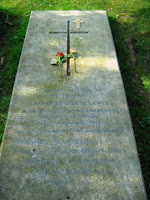 I cannot begin to describe the pleasure it was to visit so many sights related to C.S. Lewis, a man who I owe a tremendous debt of gratitude. It was through Lewis’s imaginary wardrobe into Narnia that I began my serious life-long love for “story”. Jack has shaped my thinking about literature, my philosophy of education, my spirituality and my life. I thank God for using this man for His glory and for the building up of His church. I am but one of millions who have been blessed by Jack’s writing and his life.
 Tuesday, February 24, 2009
At the Kilns: Best laid plans...
What have I been doing? I am still reading the Iliad… My “almost finished” in the previous post was a bit hasty. I am still enjoying the masterfully written epic poem, even though it is incredibly gruesome, especially now that Achilles has entered the battle field. I am truly “almost finished” now.
Another delightful diversion from my reading goals is a UK travel book by Bill Bryson. A dear friend and colleague---also a Brit---gave me this “assigned reading” in order to prepare me for my March Break tour of Britain. The book is entitled, Notes from a Small Island. It is a hilarious and interesting read, peppered with the occasional expletive. Officially, I do NOT recommend the book.
My wife and I have also started reading Jane Austen’s Pride & Prejudice together. This was an idea that emerged during a particularly cozy and delightful tea time. She has read the Austen books countless times. I have watched the A&E Pride & Prejudice countless times. Now that we are reading P&P together, I can’t believe I settled this long with the mini-series. Oh, what I have been missing!
For school, I am re-reading Old School by Tobias Wolff. A student has "accidentally" picked up my clearly marked and personally annotated copy of the novel. There are no online aids or literary guides available, so I suspect a student settled for Mr. Johnston's notes... I also re-read Euripides' play The Bacchae for my Classical Civilization course. I should really blog about this play sometime. I also saw another Greek play, Medea, by Euripides at the Canon Theatre in Toronto. I should blog about that too... sometime...
My “At the Kilns” reading has been moved to “In the Loo” reading… Christian Reflections… “almost finished”… One thing I have learned from Lewis is that I still have a lot to learn from Lewis. Reading a paragraph of C.S. Lewis is like opening a trans-dimensional worm-hole to another galaxy populated by stars of illuminating insight and planets of "down-to-earth" wisdom. What a gift to Christendom he is. I am really looking forward to visiting Oxford in March; hopefully I will be able to be---literally---“At the Kilns” .
As I near March Break, I need to decide what travel reading I will bring... if I will take a Lewis book or two to wrap up my foray "At the Kilns" or if I am going to begin foraging "At L'Abri"... Perhaps I should be more concerned about what I should pack for clothes... but in the advice of Erasmus, who once wrote (loosely translated from Latin), "When I travel, I first pack my books, and if I have any room left over, I pack underwear and clothes." Wise words.